Chapter 1:
December 12, 1992: Bob Lazar & John LearCold to the Touch
Lear's claims about a secret program and Lazar's account of the craft he said he worked on.

Second edition
A Cultural History of Art Bell
56 chapters · 7 new
Revised & expanded second edition
A Cultural History of Art Bell
Scientists, experiencers, skeptics, and strangers joined Art Bell for conversations that could become unsettling, funny, moving, or difficult to explain. This edition follows fifty-six of those broadcasts, with seven new chapters and extensively revised accounts of all forty-nine original episodes.
Kindle · Paperback · Hardcover
Reading the original edition? Use the first-edition listening guide to match its 49-chapter order.
Read an excerpt
Chapter 1 · December 12, 1992 · Bob Lazar & John Lear
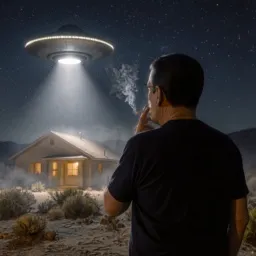
Bob Lazar said he’d worked on an alien spacecraft. Art Bell wanted to know what it was made of.
Lazar wasn’t sure.
“I say it’s metal just because I felt it,” he said. “It felt cold. It had the appearance of metal.”
Even its grain looked metallic. But Lazar couldn’t tell Art what the substance was. Information at the facility, he explained, had been compartmentalized. His work concerned the propulsion system.
Art asked whether Lazar had been inside the craft.
He had. There were two seats, a reactor, and what he called consoles, though there was nothing on top of them. Some equipment had already been removed. Art tried to picture a place from which someone could fly the thing. Were there windows? Buttons, switches, gauges?
There weren’t even wires, Lazar said.
The free listening companion
All 56 broadcasts in second-edition chapter order. The seven added chapters are marked New. Open an episode to listen, read its transcript, or explore further. Surviving recordings vary in completeness.
Lear's claims about a secret program and Lazar's account of the craft he said he worked on.
Hopkins's abduction investigations and Art's questions about encounters, memory and evidence.
Witness accounts, disputed recollections and the search for evidence from Roswell.
Zajac's interpretation of the Great Pyramid's measurements and purpose.
Mack's work with people reporting alien encounters and the controversy surrounding his approach.
McGinnis's account of Tesla's work, seized papers and the possibility of wireless power.
Walton's disappearance, the witnesses' recollections and the differences between their account and the movie.
Knapp's Russian reporting, questions about government records and Art's own sighting.
West's interpretation of the Sphinx, proposed investigations and the danger of making evidence fit a theory.
Strieber describes his encounters and explains why greater familiarity hadn't removed every doubt.
Hancock's lost-civilization argument, the barriers at Giza and an object he would rather leave unopened.
Marcel recalls the Roswell material his father brought home and the search for a surviving fragment.
Mitchell recalls Apollo 14, explores consciousness and distinguishes his UFO interests from claims about what he saw.
Martin's accounts of exorcism and Art's questions about the nature and limits of the practice.
Marrs makes his case for an alien presence while Art and a caller question how it can be established.
Corso describes an Army assignment and the material he claimed had influenced American technology.
Paglini explains her rules for magical practice, and Art asks how they apply to a private threat.
Keith and callers describe intimidating visitors, while Art questions which accounts belong together.
A frightened caller, a satellite outage and the uncertain meaning of a later confession.
Disclosure advocates discuss testimony, access to officials and the prospects for public hearings.
McKenna's ideas about consciousness, accelerating change and the future of human experience.
Hoagland and Art anticipate new Mars photographs and debate what the images could establish.
Hancock assesses the Mars images, considers impact hazards and describes a tentative truce at Giza.
Green challenges the moon landings, and Art presses him on the implications of that claim.
North predicts computer failures and social disruption as the year 2000 approaches.
Lunev describes intelligence work and his defection, then faces a caller's challenge.
McMoneagle discusses testing, feedback and the limits of accounts of remote viewing.
Von Däniken revisits ancient-astronaut arguments and responds to questions about evidence and faith.
Icke's account of hidden power meets Art's questions about the program and what constitutes truth.
Moller describes the Skycar he hopes to deliver, while Art and callers test its promises against everyday travel.
Swann recalls research, colleagues and disagreements, while resisting the title Art wants to give him.
Shostak explains the search for extraterrestrial signals and disputes Art's expectations of government secrecy.
Two Antarctic evacuations become the subject of speculation as Art and Hoagland seek an explanation.
Listeners call as the country tries to understand the attacks of September 11.
Aykroyd's interest in UFOs and Sereda's interpretation of NASA footage meet Art's practical questions.
Reynolds recounts her experience during brain surgery and answers Art's questions about perception, identity and what followed.
Mitnick describes hacking, demonstrates a telephone vulnerability and discusses life under supervised release.
Celente's economic forecasts meet Art's objections and callers' concerns about making ends meet.
An unusual object, premature interpretations and the identification that changed its story.
Lear delivers an imagined briefing and asks Art whether its disturbing contents should be made public.
Lazar returns to discuss the costs of his story, his limits and his disagreements with Lear.
Helms and Art debate emergency government, secrecy and participation in civilian communications networks.
Davenport discusses sighting reports, the limits of identification and the difficulty of getting witnesses to report.
Friedman argues for a cover-up while Art questions statistics, documents and the dismissal of SETI.
Tolces and Art disagree about surveillance, privacy and the protections that oversight can provide.
Leir reports implant findings, and Art asks about a receiver test that hasn't been performed.
Sparks describes forced lessons and encounters while Art questions the evidence and the choices he says he faced.
Knapp and Kelleher recount the ranch investigation and explain what their cameras failed to show.
Art returns with Dark Matter, asking Kaku about quantum physics, cosmic dangers and what remains unknown.
Gunter discusses Fukushima's damaged Unit 4 building and the approaching operation to remove its fuel.
Cameron moves from government records to experiencer accounts as Art asks how the claims connect.
Weidner's moon-landing argument encounters Friedman's objections and Art's questions about photography and evidence.
Paulides describes missing-person cases and disputes over records, while Art asks how unusual the pattern is.
Jacobs describes alleged integration into ordinary life, with Art asking about memory, hypnosis and corroboration.
Randle discusses disputed documents, witness accounts and the records needed to investigate them.
An open-lines evening of family, politics, cars and callers becomes Art's final full program.