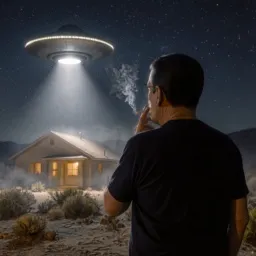
Art Bell presses Marcel on key details, from the infamous photograph staged with a weather balloon in General Ramey's office to the military's claim that the writing was merely decorative tape from a toy manufacturer. Marcel firmly rejects these explanations, noting his father's training in radar targets and aircraft identification made him uniquely qualified to distinguish the debris from any conventional material. He also clarifies that the self-restoring foil depicted in the Roswell movie was something he never personally witnessed.
Now a practicing physician in Montana, Marcel reflects on how the incident shaped his lifelong passion for astronomy and cosmology. His calm, unembellished testimony offers a rare window into the Roswell event from someone who touched the evidence with his own hands nearly fifty years earlier.
Key Moments
Father wakes him at 1 or 2 a.m. with debris: Marcel Jr. recounts how his father, Major Jesse Marcel, woke the family in the middle of the night at their Roswell home to show them metal fragments he had recovered from a field northwest of the city.
Debris dumped on the kitchen floor: Father and son unload boxes of debris from a 1942 Buick convertible and pour it onto the kitchen floor, then attempt to fit pieces together like a jigsaw to look for any electronic components.
Three types of debris: foil, bakelite-like plastic, I-beams: Marcel Jr. catalogs what he saw: dull metallic foil similar to aluminum but very light, broken black plastic resembling bakelite, and small I-beams roughly a quarter inch across with purple writing on the inner surface, the longest about 12 to 18 inches.
Symbols looked like geometric writing, not hieroglyphics: Pressed on the writing, Marcel Jr. clarifies that while it superficially resembled hieroglyphics it was really geometric symbols, and he pushes back on the Air Force claim that the markings were a flower pattern from scotch tape on balsa wood.
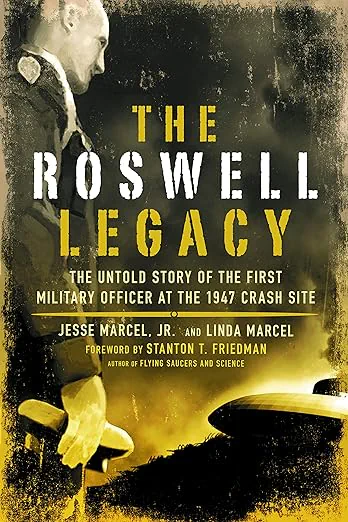
Books by This Guest
Selected titles from the guest bibliography. Use them as context for this appearance, not required listening.
Continue exploring
Paths out of this episode
A stronger next move anchored to this specific broadcast.