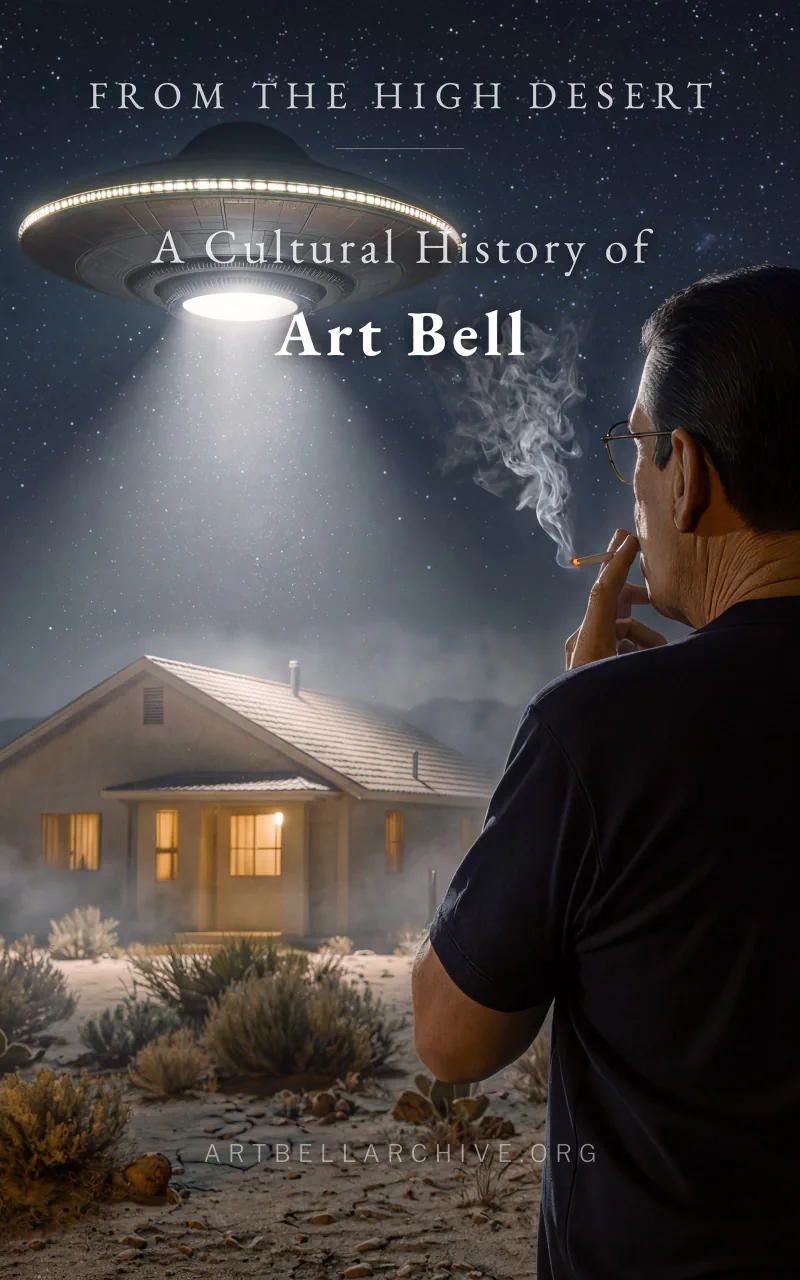
This guide follows the original 49-chapter edition. Reading the second edition? Open its 56-chapter guide.

First edition · Original listening companion
From the High Desert
A Cultural History of Art Bell
Return to the nights that made the unknown feel close.
From Area 51 and remote viewing to the voices on the open lines, follow the conversations that defined Art Bell’s late-night world. Each chapter returns to a broadcast, placing its guests, claims, and questions in historical context.
49 chapters · Broadcasts from 1992–2016
Hardcover, paperback, or Kindle
Digital download through Payhip
The stories behind the signal
Revisit the witnesses, researchers, and callers who brought their extraordinary accounts to the microphone.
A history of listening
Explore the cultural moment around the broadcasts, and the questions that kept people listening through the night.
Read, then hear it for yourself
Follow the free listening companion below to return to the original conversations as you read.
Read an excerpt
Cold to the Touch
Chapter 1 · December 12, 1992 · Bob Lazar & John Lear
In the predawn hours of December 12, 1992, a physicist with no reason to lie told millions of listeners that he had touched an extraterrestrial spacecraft hidden in the Nevada desert. The reactor powering it ran on an element that should not exist, and the craft moved by bending space itself. For a few moments on live radio, the most dangerous secret in American history hung in the air between Pahrump and the stars.
The call came in sometime after 3:00 a.m. Pacific time. The audience had thinned to the true believers and the sleepless: the long-haul truckers and graveyard shift workers who found a companion for the loneliest hours of the early morning. John Lear had been holding court for hours, spinning theories about alien visitation and government cover-ups with the confidence of a man who had seen too much to care what anyone thought. When Art Bell announced that Bob Lazar was on the line to take questions, something shifted in the broadcast. The speculation had suddenly become testimony.
Continue reading the excerpt
Bob Lazar had emerged from obscurity three years earlier through a series of investigative reports by Las Vegas journalist George Knapp. His claims were extraordinary: he had been hired to work at S-4, a facility located south of the infamous Groom Lake installation in the Nevada Test Site. His job was to reverse-engineer the propulsion system of an extraterrestrial spacecraft. He was not there to study it from afar or read briefing documents. His task was to put his hands on it, peer inside its reactor, and watch it lift silently off the hangar floor during a test flight.
What made Lazar different from the countless UFO claimants populating the fringes of American culture was his specificity. He avoided mystical generalities and recovered memories, instead speaking exactly like what he claimed to be: a scientist describing hardware.
“I worked on one particular craft,” Lazar told Art Bell that night. His voice carried the practiced calm of someone who had told this story before and no longer expected to be believed. “I called it the sport model, because it has a very sleek appearance. There was a small reactor that was removed from the craft, and we essentially back-engineered it. What we needed to do was find out not only how it worked, but also very important to the project was to see if this technology could be duplicated.”
Art pressed him for details, and Lazar obliged. He described a craft constructed of a substance that felt cold to the touch, featuring a grain structure that appeared metallic but may have been something else entirely. The interior had been stripped of much of its original equipment, leaving only two seats and two of the three original consoles. What struck Lazar most was the absence of what any earthly vehicle would contain: there were no buttons, switches, or wiring in any conventional sense.
“It really wasn’t anything like that,” he said when Art asked about controls. “There wasn’t, it really wasn’t even wiring. A lot of the equipment, it almost appeared to be something similar to a Tesla coil. Every piece of equipment was tuned to whatever it was supposed to be receiving signals from. It was essentially electrical power transmission without wires.”
From chapter 1 of From the High Desert: A Cultural History of Art Bell.
Hardcover, paperback, or Kindle
Digital download through Payhip
The free listening companion
Return to the broadcasts
These 49 broadcasts follow the published book’s chapter order. Find a chapter, open its episode, and listen as you read. The archive remains free to explore, whether or not you buy the book.
49 companion broadcasts · 1992–2016
The Intruders Among Us
The Debris Field
The Stone That Speaks
The Harvard Heretic
The Man Who Would Give the World Free Power
The Light in the Clearing
The Watchers at the Gate
The Riddle in Stone
A Species with Amnesia
The Boy Who Touched the Stars
The Priest Who Knew the Devil
The Investigator's Burden
The File Cabinet
The Shadow Agents
The Night the Signal Died
The Night the Government Listened
Death by Astonishment
The Monuments of Cydonia
The Shadows on the Moon
The Thousand-Pound Gorilla
The Red Planet's Secret
Through the Eyes of the Enemy
Remote Viewer 001
The Gods Who Walked Among Us
The Web That Binds the World
The Father of Remote Viewing
Something Wrong at the Bottom of the World
The Night the World Changed
The Masters of Water
Armed With a Keyboard
The Five O's of Collapse
The Story of the Claw
The Lear Test
The UFO Guy
The Shadow Republic
The Collector’s Lament
The Cosmic Watergate
The Vacuum Cleaner
The Surgeon and the Scalpel
Alien Boot Camp
The Portal and the Phantom
Fourteen Thousand Hiroshimas
The Most Classified Secret
The Front-Screen Projection
Without a Trace
Walking Among Us
The Dossier
Good Night
Take the high desert with you.
Choose the edition that fits the way you read.
Hardcover, paperback, or Kindle
Digital download through Payhip