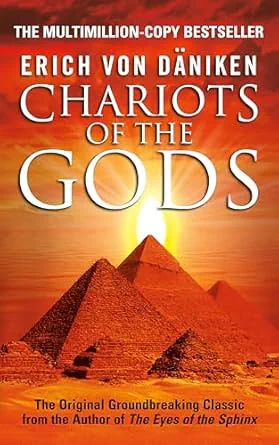
The conversation delves into von Daniken's belief that extraterrestrials genetically modified early hominids to create intelligent humans, a concept he finds echoed across world religions. He points to the Hebrew word Elohim, a plural form suggesting multiple gods, and draws parallels between the story of Adam and Eve and a deliberate act of genetic engineering. Von Daniken also discusses hidden artifacts, including the Ark of the Covenant guarded beneath an Ethiopian cathedral and a mysterious mirror buried with a Japanese emperor.
Callers challenge von Daniken on spiritual versus physical interpretations of scripture, while he addresses past criticisms of his earlier work. He acknowledges youthful errors in Chariots of the Gods but maintains that his newer books, including The Arrival of the Gods, meet scientific standards. He also announces plans for a mystery-themed park in Interlaken, Switzerland, designed to bring the world's ancient enigmas to the public.
Key Moments
Why land at Nazca: minerals and ancient witnesses: Von Daniken proposes that one of the Vimanas described in ancient Indian texts made a landing on the plain of Nazca in Peru, drawn by the area's gold, silver and other minerals - and that the natives, watching from a distance, mistook the visitors for gods and later copied their landings as the famous lines.
The Ark of the Covenant as extraterrestrial technology: Von Daniken claims the Ark of the Covenant was a technical device left by the gods of the Bible, and that according to the Ethiopian Kebra Negast its remains are still kept under the Cathedral of the Virgin Mary in Aksum, Ethiopia, guarded with guns and impossible to examine.
Genesis as genetic engineering: Adam and Eve in the lab: Von Daniken describes how an extraterrestrial crew arriving on Earth would take a cell from a Neanderthal-like ancestor, modify the DNA, grow it in a nutrient liquid, then implant it back into a female of the same species - producing the genetically altered pair the Bible remembers as Adam and Eve in the Garden of Eden.
Plural Elohim: 'the gods created man': Von Daniken says he learned Hebrew as a Jesuit-educated boy translating the Old Testament and that the original word in Genesis is Elohim - a plural - so the line should read 'the gods created man after their own image,' a reading he says is mirrored in Hindu and Central American creation texts.
Best evidence: the Palenque tombstone astronaut: Asked for his strongest physical evidence, Von Daniken points to the carved slab beneath the Temple of Inscriptions at Palenque in Mexico - a ten-ton stone showing a man bent forward, hands on controls, heel on a pedal, inside a frame with flame coming out the back, which he says nobody can look at honestly and still deny extraterrestrials.
Books by This Guest
Selected titles from the guest bibliography. Use them as context for this appearance, not required listening.