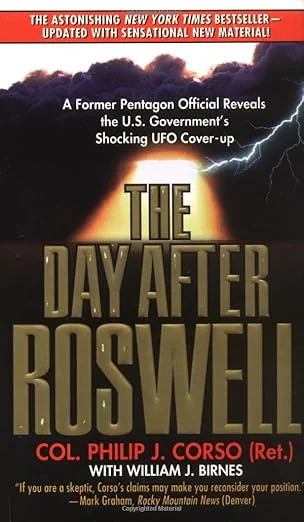
July 6, 1997: The Day After Roswell - Colonel Philip J. Corso & William J. Birnes
Birnes describes the fierce internecine warfare between military intelligence and the CIA during the Cold War. Army leaders distrusted the civilian intelligence apparatus, believing it had been penetrated by Soviet agents. This distrust shaped the decision to keep recovered alien technology strictly within military channels. Corso then describes the file cabinet General Trudeau assigned him in 1961, filled with artifacts from the Roswell crash.
Corso details how he and Trudeau seeded alien technologies into American industry through standard R&D contracts. Items from the cabinet became precursors to integrated circuit chips, fiber optics, lasers, night vision devices, and super tenacity fibers. He also discusses Project Horizon, a classified Army plan for a lunar outpost, and directed energy weapons derived from recovered materials.
Key Moments
Corso recounts seeing the Fort Riley body in 1947: Corso says he was post-duty officer at Fort Riley around 3 a.m. when a sergeant showed him a tarp-covered crate; he lifted it and saw a small body floating in liquid for roughly 15 seconds.
Description of the entity and the five-truck convoy: Corso describes the entity's large head, slit features and spindly limbs under five feet tall, then asks the sergeant where it came from - told it was moving from Roswell via Fort Riley to Wright-Patterson.
Reverse-engineering claim: IBM, Hughes, Bell Labs, Dow Corning: Linda Moulton Howe summarizes Corso's central thesis: Army R&D under General Trudeau seeded reverse-engineered Roswell technology - integrated circuit chips, fiber optics, lasers, super-tenacity fibers - to IBM, Hughes Aircraft, Bell Labs and Dow Corning without their knowledge.
Trudeau hands Corso the Roswell file cabinet: Corso says shortly after his Foreign Technology Division appointment, General Trudeau delivered him a file cabinet of Roswell artifacts and told him to draft a plan of action - later joking it was 'Corso's nut file.'
Books by These Guests
Selected titles from the guest bibliography. Use them as context for this appearance, not required listening.
Collection
More collections featuring this episode
Continue exploring
Paths out of this episode
Stronger next moves anchored to this specific broadcast.