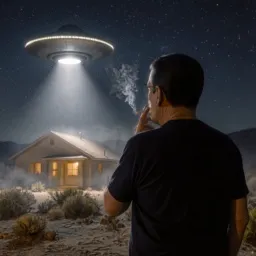
Professor Kaku explains the discovery of the Higgs boson, comparing the process to throwing a piano from a building and reconstructing it from the crash. He describes dark matter as invisible, ghost-like substance that passes through solid objects and oscillates through the Earth, and shares hopes that the Large Hadron Collider may create it in the laboratory. The discussion turns to whether bigger colliders could pose dangers, with Kaku arguing that cosmic rays already exceed anything humans can produce.
The pair explores the explosion of exoplanet discoveries, with Kaku estimating roughly a billion Earth-like planets in the Milky Way alone. They debate the Fermi Paradox, the possibility that Type 0 civilizations routinely destroy themselves before advancing, and the prospects for fusion energy within the next decade.
Key Moments
Why Art really left - the Premier Radio confession: On the very first Dark Matter broadcast, Art breaks years of silence to explain his long absence: a false child-molestation rumor was spread about him on international radio, and Premier Radio's lawyer dismissed it in an internal memo as 'a worthless lawsuit, and besides Premier had not been defamed.' He fought it himself, walked, and only returned when they agreed to drop four minutes of commercial time per hour.
Quantum entanglement explained: Kaku confirms Einstein was wrong about non-locality: two electrons brought into the same vibration stay invisibly linked across the galaxy. Measure one's spin and you instantly know the other's, faster than light - though Einstein got the last laugh because the information transmitted is random.
Art's quantum-consciousness theory and twins: Art pushes Kaku into uncomfortable territory, suggesting consciousness itself may have a quantum link - citing twins who feel each other's pain across the world. Kaku replies that Nobel laureate Eugene Wigner believed quantum theory proves there must be a cosmic consciousness, because observation requires a conscious observer.
Type 0 to Type 1 - 50/50 odds: Kaku walks through the Kardashev scale and tells Art he's now more optimistic than he was years ago - 50/50 odds humanity makes the historic transition from Type 0 to Type 1, helped by the internet spreading democracy, and democracies don't war with each other.
A billion Earth-like planets in our backyard: Kaku reveals the Kepler-era census: over 50% of stars in the Milky Way have planets, roughly one in 200 has an Earth-like planet, meaning a billion Earths in our own galaxy. Art and Kaku agree: we may be sitting in the middle of a galactic communication network and be too primitive to know it.
Books by This Guest
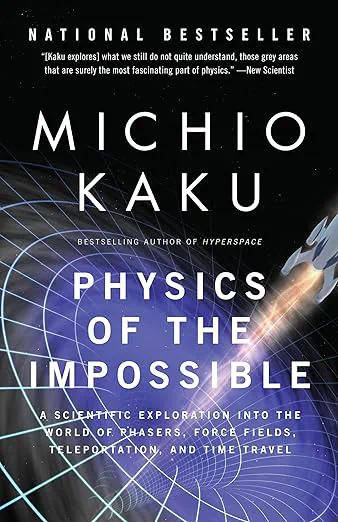
Selected titles from the guest bibliography. Use them as context for this appearance, not required listening.
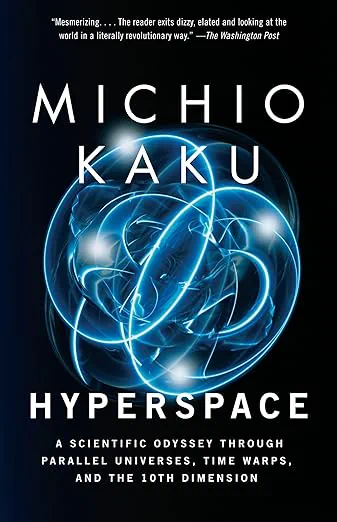
Hyperspace: A Scientific Odyssey Through Parallel Universes, Time Warps, and the 10th Dimension
1994
Collection
More in this collection
Continue exploring
Paths out of this episode
Stronger next moves anchored to this specific broadcast.