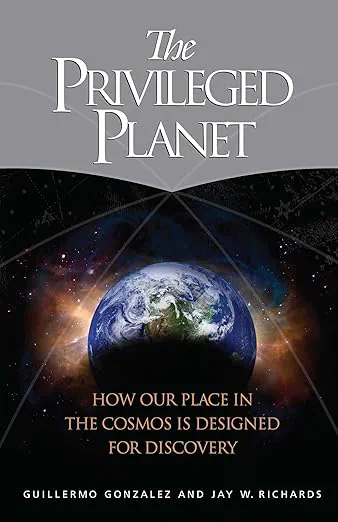
Art then welcomes Professor Guillermo Gonzalez, an astronomer at Iowa State University, to discuss his book The Privileged Planet. Gonzalez presents a modified Drake equation with twenty factors instead of the original seven, arriving at an upper limit of less than one percent probability that another civilization exists in our galaxy. He shares his personal belief that intelligent life on Earth may be unique in the entire universe, a position he reached after years of study despite early enthusiasm for SETI.
The conversation covers panspermia, the transfer of life between planets via asteroid impacts, and the controversial Allan Hills meteorite from Mars. Art reports picking up a strong signal at 1420 megahertz, the protected hydrogen frequency, and describes his attempts to reach SETI for confirmation. Gonzalez discusses how Earth's rare conditions for supporting life also make it ideally suited for scientific observation of the cosmos.
Key Moments
The Privileged Planet hypothesis: Gonzalez frames his thesis: the rare places in the universe that can host complex intelligent life are the same places where that life can most efficiently make scientific discoveries.
Drake equation expanded from 7 to 20 factors: Gonzalez says he and Richards published a new version of Drake's equation in Appendix A of the book, expanding Frank Drake's original 1960 seven-factor formula to twenty factors.
The galactic habitable zone and its two life-killers: Gonzalez explains the galactic habitable zone - work he did with Peter Ward and Don Brownlee - bounded by two threat classes: radiation events (supernovae, gamma-ray bursts, the central black hole's accretion flares) and impactors from the Oort cloud.
Mainstream-science Drake math gives a near-empty universe: Gonzalez emphasizes the new equation uses straight mainstream science with no religious assumptions, and even on those terms concludes life - and especially civilizations - are extremely rare; we may be the only one.
The universe is designed for scientific discovery: Gonzalez articulates the deeper claim that goes beyond rare Earth: the same conditions that permit life also make the universe maximally observable to that life - which he reads as evidence that the cosmos is designed for discovery.
Books by This Guest
Selected titles from the guest bibliography. Use them as context for this appearance, not required listening.