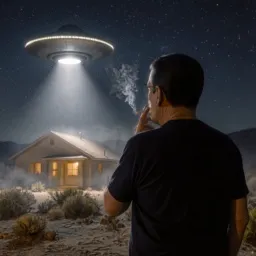
May 14, 1996: Moon Debate - Richard C. Hoagland & Dr. Edgar Mitchell
Mitchell pushes back firmly but thoughtfully, acknowledging that photographic anomalies may exist while insisting Hoagland is pushing his data far beyond what it supports. The astronaut argues the evidence more likely reflects optical artifacts or unknown physics rather than artificial construction. He challenges Hoagland on how six Apollo missions could have descended through such structures unharmed. The discussion extends into lunar seismic data, NASA classification authority under the Space Act, and the Brookings Report's recommendation to potentially withhold evidence of extraterrestrial intelligence.
What emerges is a surprisingly respectful exchange between two sharp minds approaching the same data from radically different frameworks. By the broadcast's end, Mitchell agrees to assist with further investigation, and both men find unexpected common ground on the need to pursue anomalous evidence wherever it leads.
Key Moments
Hoagland presents the Apollo 14 panorama anomaly: Hoagland describes a 360-degree handheld panorama Shepard took near Antares - assembled from prints sequestered by Ken Johnston - showing bluish brightening and angular detail above the lunar horizon, with scattering that varies systematically with the sun angle.
Mitchell concedes the panorama anomaly but presses Hoagland on what is there: Mitchell says directly, 'I cannot disagree with anything you've said to this point,' then asks Hoagland to specify the configuration and physical scale of whatever is producing the scattering above an airless world that should have nothing above the horizon.
Hoagland invokes the long-duration lunar seismic ringing: Hoagland argues the ALSEP seismometer data - the Moon ringing like a bell for hours after impacts, beginning on Apollo 11 and 12 - is consistent with a glass-trestle structure, citing his pre-mission discussions with PI Gary Latham at Columbia.
Mitchell reframes the debate: anomaly yes, unnatural structure no: Mitchell pivots to common ground - invoking non-locality and his own work on consciousness - and proposes that whatever Hoagland is seeing should first be approached as anomalous but natural physics, not as artificial structure left by another intelligence, until that path is exhausted.
Mitchell confirms he was never gagged by NASA on what he saw: Hoagland reads from the 1958 NASA Space Act and the 1959 Brookings Report's recommendation to consider withholding ETI discoveries; Mitchell responds flatly that scientific data from the missions was not classified and that astronauts received no briefing on classification beyond a routine voice-circuit delay for profanity.
Books by These Guests
Selected titles from the guest bibliography. Use them as context for this appearance, not required listening.
Continue exploring
Paths out of this episode
A stronger next move anchored to this specific broadcast.