
Mallett walks through the science methodically, explaining how both speed and gravity slow time according to Einstein's two theories of relativity. He reveals his key discovery: circulating light beams can twist space, and if twisted strongly enough, time bends into a loop allowing movement from the future back into the past. He uses vivid analogies, comparing curved space to a rubber sheet bent by a bowling ball and stirred coffee in a cup.
The discussion addresses time travel paradoxes through parallel universe theory from quantum mechanics. Mallett explains that arriving in the past creates a split, placing the traveler in a new universe where changes affect only that timeline. He notes one critical limitation: the machine only permits travel back to the moment it was first activated, explaining why no time travelers have yet appeared among us.
Key Moments
A 10-year-old reads H.G. Wells and decides to build a time machine: Mallett explains the personal origin of his physics career: his father died of a heart attack when he was 10, and after reading The Time Machine he resolved to build one so he could go back, see his father again, and warn him about his death.
Twisting space with a circulating light beam: Mallett walks Art through the core of his proposal: bouncing a laser between four mirrors to create a circulating light beam, then using Einstein's general relativity (where energy itself curves space, illustrated by a bowling ball on a rubber sheet) to twist empty space and ultimately twist time into a closed loop.
Why the grandfather paradox isn't a paradox: Mallett invokes the parallel-universe interpretation of quantum theory: the moment a traveler arrives in the past, the universe splits, so the past you change is not the past you came from. You could prevent your grandfather's marriage and still exist-just in a different branch.
Why we haven't been visited by time travelers yet: Answering Hawking's classic challenge, Mallett argues a real time machine is not magic-it's a device that creates a channel back to the moment it was first turned on. Travelers cannot arrive earlier than the machine's switch-on, so the absence of visitors simply means the first machine has not yet been built.
Time travel in the hands of terrorists: Mallett raises the ethics of the technology he is trying to invent, warning that time travel in the hands of terrorists would demand regulation. He calls for an eventual 'time travel commission' to oversee abuses, citing the film Timecop as a surprisingly serious model.
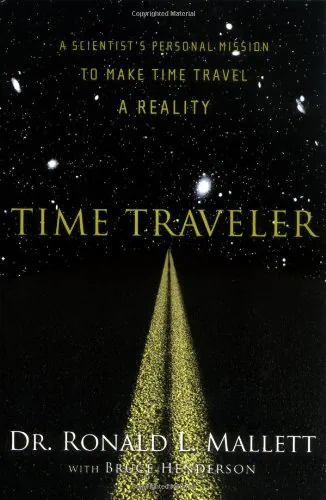
Books by This Guest
Selected titles from the guest bibliography. Use them as context for this appearance, not required listening.
Continue exploring
Paths out of this episode
A stronger next move anchored to this specific broadcast.