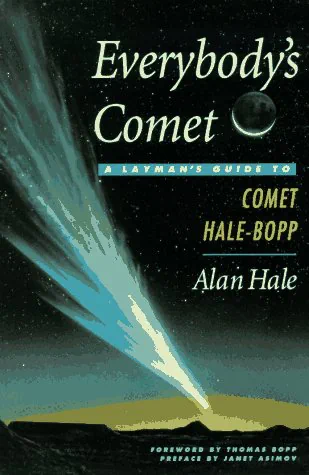
The discussion covers the comet's unprecedented brightness at great distance, its carbon monoxide-driven outgassing, the dual tail structure of ionized gas and dust particles, and Hale's forecast that peak viewing will come in early to mid-April. Art asks pointed questions about the Chuck Shramek companion object controversy, which Hale dispatches as a bright overexposed star with diffraction artifacts. They also explore near-Earth asteroid threats, the Cretaceous extinction impact, and the disappointing retreat from manned space exploration since Apollo.
Hale brings scientific rigor and genuine enthusiasm to a subject swirling with conspiracy and myth. His firsthand account of discovery, combined with accessible explanations of cometary physics, makes this an essential episode for anyone watching the once-in-a-lifetime visitor blazing across the predawn sky.
Key Moments
Bell and Hale clear the air on Courtney Brown: Bell opens by addressing his prior falling-out with Hale over the Courtney Brown / Chuck Schramek 'Saturn-like object' affair - Hale had publicly called Coast 'the weekly world news of radio.' Both agree the comet matters more than the fight.
Discovery night: Sagittarius cluster, an hour to kill: Hale walks Bell through the discovery in unhurried detail: first clear night after a week and a half of rain, two known comets to follow, an hour to kill before the second one rose, telescope swung at a star cluster in Sagittarius, a small fuzzy thing nearby in the eyepiece. Star atlas check, online check via the Central Bureau for Astronomical Telegrams in Cambridge - nothing cataloged. He went outside, looked again, and saw it had moved against the background stars.
Why an amateur scooped Palomar and Mauna Kea: Bell asks why a backyard astronomer beat the great university telescopes. Hale: Kitt Peak, Palomar, Mauna Kea use very large instruments with very small fields, dedicated to specific research targets - they don't do survey work, so an amateur is actually more likely to find a comet than a major observatory.
How big is Hale-Bopp - Hubble's 40 km estimate: Hale gives the size question its proper hedged answer. The nucleus is invisible behind its own outgassing cloud; no spacecraft is being sent and the comet is too far for radar (as JPL did with Hyakutake). Hubble Space Telescope images from fall 1995, with assumptions, give a most-likely diameter of 40 km / 25 miles, with an upper limit around 70 km - well below the 100-mile-plus rumors.
Preserved source
From the original ArtBell.com archive
The 2003 commemorative archive preserves the contemporary listing for this broadcast. Links and descriptions reflect the original site and may be outdated.
View the original program listingBooks by This Guest
Selected titles from the guest bibliography. Use them as context for this appearance, not required listening.