Art Bell’s Lear Test: Would You Tell the World?
Hear John Lear’s complete briefing, take the test with Art, then compare the answers from Davenport, Kosko, Lazar and Greer.
Watch the complete evidence timeline
The claim under review
If everything in Lear’s briefing were true, would you tell the public? Decide before hearing how Art Bell and his guests answered.
What the surviving record establishes
The broadcasts preserve different reasons for disclosure and secrecy. Agreeing to consider Lear’s premises is separate from endorsing them, and a guest’s yes or no is incomplete without the explanation that follows.
Take the test before hearing the answers
On November 2, 2003, John Lear gave Art Bell a briefing and asked him to make a decision. If the account were true, and the choice were yours, would you release the information to the public?
The episode preserves Lear’s complete original briefing, followed by Art’s response. Listen first and decide for yourself. The later broadcasts bring the same question to Peter Davenport, Bart Kosko, Bob Lazar and Steven Greer. Their explanations turn a yes-or-no question into a disagreement about public duty, risk and what people could do with the information.
What Lear asks Art to decide
Lear describes a succession of slides and films that radio listeners cannot see. His account joins alleged recoveries, secret agreements, disappearances, concealed information about space exploration and a program operating beyond ordinary public oversight. Art is asked to accept the briefing’s premises before deciding whether to disclose them.
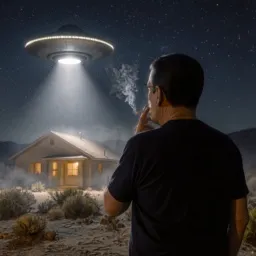
The surviving recording is evidence of the exchange: what Lear said, how he posed the choice, and how Art responded. The illustrations in this episode help follow that account. They do not reconstruct the alleged slides or supply independent evidence for the events described.
Art worries about the people who would hear it
Art first challenges the circumstances of the briefing. He worries about personal danger and asks whether the people presenting such information would really permit its release. Lear tries to bring him back to the decision itself.
Art ultimately says no. His explanation concerns the effect on government, religion and the audience he knows from years of broadcasting. He expects disclosure to turn people’s lives upside down. That is the judgment preserved in this exchange; it does not establish that the public would actually respond as he feared.
Davenport: an obligation to the public
On November 15, Peter Davenport says he would consult trusted counsel. If he had to decide immediately, however, he would tell the American people.
He describes leadership as an obligation that includes giving people difficult news. When he asks where his loyalty lies, he comes back to his neighbors, his friends and the public. His answer begins with responsibility toward those people.
Kosko: more people working on the problem
Later that night, Bart Kosko also favors release. He expects shock, but sees a reason to give the information to more people: knowledge is distributed, and a large public might find solutions unavailable to one person or a small group.
Kosko draws on brains and markets to explain how separate contributions can produce results that no individual could reach alone. Art hears a danger to the public; Kosko also hears a problem the public might help solve. Both are discussing the consequences of the same briefing.
Later in the November 15 broadcast, a caller challenges the test’s assumptions. Kosko defends reasoning from an assumed premise. That makes the exercise useful for considering a decision, without establishing the truth of the premise.
Lazar agrees about secrecy, with reservations
On December 6, 2003, Bob Lazar asks about the Lear Test. Art explains it and makes an important distinction: Lear believes things that Lazar does not accept.
Lazar still agrees with Art about keeping the information secret. He also says he hopes everything Lear believes is not true. Agreement on the decision does not make Lazar a witness to every claim in the briefing, or make his beliefs interchangeable with Lear’s.
Greer’s answer has two parts
The following night, Art asks Steven Greer what he would do if the briefing were true. Greer answers no under that assumption, then immediately disputes the briefing itself.
He estimates that roughly three-quarters of its points are probably incorrect, while acknowledging that he would need to examine it more closely. That percentage is Greer’s assessment, not an independent verification.
Quoting only his refusal would omit his objection. The recording preserves both parts: a decision under the stated assumption and a challenge to the assumption’s accuracy.
The test becomes a recurring question
When Lear returns on March 21, 2004, Art explains that he had extracted the briefing and played it for disclosure advocates. He says he stopped putting guests on the spot after so many had heard it that they arrived with an answer prepared.
That recollection does not establish permanent abandonment. Art still invokes the Lear Test in June 2005. The later reference is included below as a chronology check.
The value of the sequence is in the reasons. Davenport emphasizes duty to the public. Kosko wants more people working on the problem. Lazar agrees about secrecy while reserving judgment on Lear’s claims. Greer accepts the question conditionally and disputes much of its premise. Did any of those arguments change your first answer?
Broadcasts Used in This Investigation
November 2, 2003: Aerial Revelations - John Lear
Art’s setup, Lear’s complete briefing and Art’s response. Lear introduces the test earlier, at 01:00:30.
November 15, 2003: UFO Reports - Peter Davenport | Nanotechnology & Fuzzy Logic - Bart Kosko
Davenport’s answer. Kosko’s response begins at 01:11:43; the later challenge to the exercise begins around 02:32:46.
December 6, 2003: UFOs and Alternative Energy - Bob Lazar
Art distinguishes Lazar’s beliefs from Lear’s; Lazar agrees on secrecy while retaining his reservations.
December 7, 2003: The Disclosure Project - Dr. Steven M. Greer | Alien Craft - Bill McDonald
Greer’s conditional no and immediate objection to the briefing’s accuracy.
March 21, 2004: UFOs - John Lear
Art recalls replaying the briefing and why he stopped surprising guests with it.
Key Archive Threads
The same question, different reasons
Davenport’s public duty and Kosko’s collective problem-solving lead to the same answer for different reasons.
Open source episodeA decision is not an endorsement
Lazar’s agreement about secrecy does not erase his disagreement with Lear’s beliefs.
Open source episodeKeep the qualification with the answer
Greer’s refusal is conditional; his challenge to the account follows immediately.
Open source episodeRelated Episodes
June 25, 2005: Grand Funk Railroad - Mark Farner | Alien Presence & Government Disclosure - Sgt. Major Robert O. Dean
Art still invokes the Lear Test in 2005, after his March 2004 recollection of stopping its surprise use.