
Art shares his own encounter with a massive, silent, triangular craft that floated over his car near Area 51, and Cook confirms these sightings fit a global pattern of reports describing large, noiseless triangular objects that defy conventional aerodynamics. He notes that nothing in Jane's All the World's Aircraft matches these descriptions. Cook also discusses BAE Systems' interest in Podkletnov's work and Lockheed Martin's exploration of similar concepts.
The conversation turns to zero point energy, the theoretically proven sea of electromagnetic particles that flash in and out of existence throughout all space. Cook explains how harnessing this field could revolutionize propulsion, eliminate dependence on fossil fuels, and open the door to interstellar travel. He traces the mystery back to 1950s aerospace companies that publicly discussed anti-gravity breakthroughs before suddenly falling silent.
Key Moments
The brown envelope: Boeing's secret Podkletnov antigravity proposal: Cook describes how, while researching propellantless propulsion for Jane's, an unsolicited 44-page Boeing proposal arrived through his door detailing plans to work with Russian scientist Evgeny Podkletnov on an impulse gravity generator that produces a repulsive gravity-like beam.
Two percent weight loss above a spinning superconductor: Cook explains Podkletnov's original claim, that objects placed above rapidly spinning superconductors lose about two percent of their weight, and his impulse gravity generator that pulses electricity through the same superconductor to produce a repulsive beam.
Casimir, the sea of energy, and what happens when oil is obsolete: Cook explains the Casimir effect and the zero-point field as a sea of electromagnetic energy filling space, ties it to string theory's extra dimensions, and Bell pushes the consequences: if harnessed, every petrochemical-driven car, plane, and oil company is obsolete.
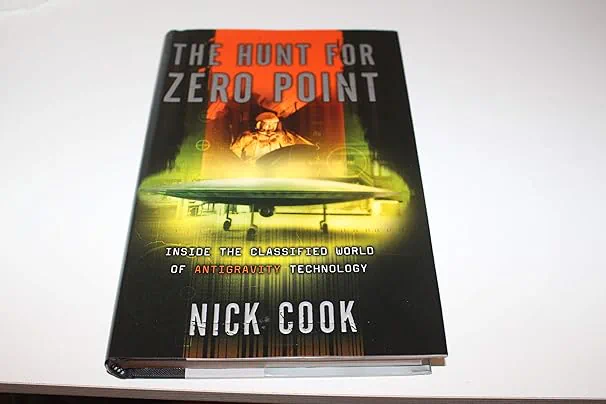
The 1950s antigravity articles that suddenly went silent: Cook says what set him writing The Hunt for Zero Point was a mid-1950s Popular Science article in which named aerospace companies promised an antigravity breakthrough within four or five years, then mysteriously fell silent, paralleling how 1930s atomic-bomb scientists went quiet before the Manhattan Project.
Books by This Guest
Selected titles from the guest bibliography. Use them as context for this appearance, not required listening.
Continue exploring
Paths out of this episode
Stronger next moves anchored to this specific broadcast.