September 30, 2006: Consciousness and the Brain - Dr. Stuart Hameroff
Dr. Hameroff presents his theory that consciousness originates not in neural firings but in subtler quantum activity within dendrites, specifically inside protein structures called microtubules. He challenges predictions that computers will match human consciousness by 2030, arguing that classical computation fundamentally cannot produce awareness and that only a specific type of quantum computer could theoretically achieve it.
The conversation turns to implications for near-death experiences, non-local communication, and free will. Dr. Hameroff suggests that quantum information persists at a fundamental level of spacetime geometry even after the brain stops functioning, potentially explaining how consciousness could survive physical death. He discusses how quantum mechanics may allow information from the near future to influence present decisions, offering a scientific basis for real-time conscious control rather than the illusion mainstream neuroscience proposes.
Key Moments
How Hameroff got into anesthesia and consciousness: Hameroff recounts being told by Burnell Brown, the first head of anesthesia at Arizona, that if he wanted to understand consciousness he should figure out how anesthetic gases work because they are the most selective tool we have on awareness.
Anesthetic gases stop consciousness and nothing else: Hameroff describes the central mystery: under inhaled anesthetics the brain stays measurably active, EEG and evoked potentials continue, autonomic regulation continues, yet the gases occupy tiny pockets in the brain and selectively switch off awareness.
Anesthesia works by quantum forces, not chemical bonds: Hameroff explains that, unlike other psychoactive drugs, anesthetic gases form no chemical bonds. They interact via weak quantum London forces in hydrophobic protein pockets, suggesting consciousness itself is a quantum process the gases dampen.
Why a 2030 silicon brain still won't be conscious: Hameroff dismisses Kurzweil's singularity: even if Moore's law holds and computers match neuron counts by 2030, neurons firing are not the fundamental unit of consciousness. The action lives in the dendrites, in subtle quantum processes a classical computer cannot replicate.
Free will requires quantum signals from the near future: Hameroff confronts the Libet problem head-on: brain activity for conscious recognition lags our actual responses, which forces mainstream neuroscience into a no-free-will position. His escape route is quantum information arriving from the very near future, allowing real-time conscious control.
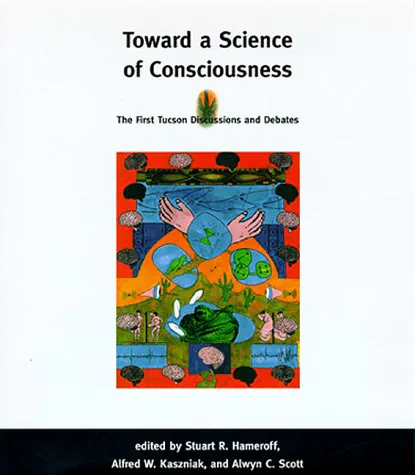
Books by This Guest
Selected titles from the guest bibliography. Use them as context for this appearance, not required listening.
Collection
More in this collection
Continue exploring
Paths out of this episode
Stronger next moves anchored to this specific broadcast.