Author Douglas Mulhall joins from the Bahamas to explain how nanotechnology is already transforming everyday life through stain-resistant fabrics, longer-lasting tennis balls, and invisible zinc oxide sunscreens. He describes how carbon nanotubes, with 30 times the tensile strength of steel, have made a space elevator feasible at a fraction of current launch costs. Mulhall reveals that manufactured diamonds indistinguishable from mined stones are now being produced cheaply, promising computing speeds 100 times faster than silicon processors.
The conversation turns to nanomedicine, where gold nanotubes coated with antibodies already perform rapid blood diagnostics. Mulhall discusses the discovery of nanobacteria, a mysterious pathogen smaller than any known bacterium that forms calcium shells and may trigger heart disease, and explains how existing drugs like tetracycline can destroy it.
Key Moments
Nanotech 101: chemistry, not tweezers: Mulhall defines nanotechnology as manipulating matter at the billionth-of-a-meter scale and explains that today's real progress comes through chemistry, not the IBM-style scanning-tunneling pickup of single atoms.
Nanobacteria - a third kind of life?: Mulhall walks through the Scripps researcher who discovered nanobacteria - particles smaller than viruses, with a single DNA-like strand, now linked to heart disease and challenging the definition of life.
Gray goo explained: Art asks Mulhall to define gray goo. Mulhall describes a self-replicating nanomachine that treats carbon-based life as raw material, and Art summarizes how it would consume dirt, rocks, houses, people - everything in its path.
Why ecosystems may save us: Mulhall counters the gray goo scenario with the argument that for every runaway monster nature evolves a counterbalance, citing Ray Kurzweil's view that technology is evolution by other means and will develop its own ecology.
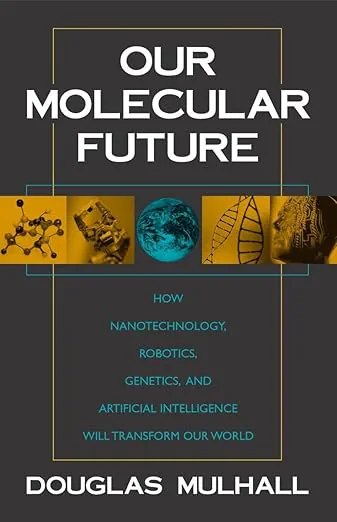
Books by This Guest
Selected titles from the guest bibliography. Use them as context for this appearance, not required listening.
Continue exploring
Paths out of this episode
A stronger next move anchored to this specific broadcast.