
Howe interviews Dr. Greg Wiles of the College of Wooster, who reports that Alaska's temperatures have risen five degrees Fahrenheit since 1968, exactly as global warming models predicted for northern regions. This accelerated warming is causing permafrost to melt, dropping the water table below tree roots and killing vast stands of white spruce across Alaska's boreal forest.
Geophysicist Dr. Mike Meyer of the University of Colorado discusses projected sea level rise of approximately half a meter by 2100. He explains that even modest rises translate to 150 feet of coastline retreat due to flat coastal slopes, threatening wetlands and freshwater estuaries worldwide. Meyer notes that the polar ice caps remain too cold for near-term catastrophic collapse but urges policymakers to factor rising seas into all coastal development decisions.
Key Moments
Polybrominated chemicals found in sperm whales feeding 3,000 feet down: Howe opens with new research from Dutch scientists at the Netherlands Institute for Marine Research who found man-made polybrominated chemical compounds in stranded sperm whales. Because sperm whales feed at 3,000 feet, the contamination implies industrial pollution has penetrated the deep Atlantic food chain.
Spain's glaciers cut in half, Alaska warming five degrees since 1968: Howe stacks the data: Spain's glacier count has dropped from 27 to 13 since 1980, Glacier National Park is projected to lose all of its glaciers next century, and while global average temperature has risen one degree Fahrenheit in the 20th century, Alaska, northwestern Canada, and Siberia have warmed five degrees Fahrenheit since 1968 - exactly what global-warming models predicted.
A foot and a half of sea rise equals 150 feet of coastline retreat: IPCC scientist Dr. Mark Meier explains to Howe that even the best-case projection of about half a meter of sea level rise by 2100 translates into roughly 150 feet of coastline retreat because most shorelines slope at about 100 to 1, and the saltwater wedge in estuaries will push inland a thousand times the rise.
Books by This Guest
Selected titles from the guest bibliography. Use them as context for this appearance, not required listening.
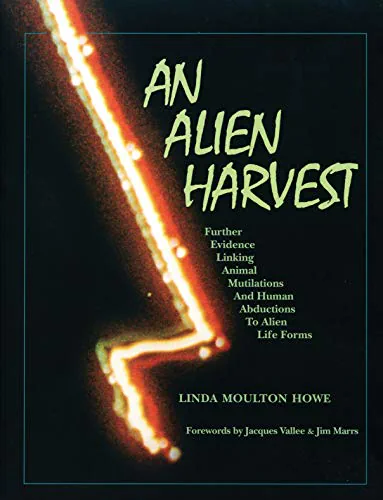
An Alien Harvest: Further Evidence Linking Animal Mutilations and Human Abductions to Alien Life Forms
1989

Continue exploring
Paths out of this episode
A stronger next move anchored to this specific broadcast.