
The professor explains how Einstein's theories of relativity provide the foundation for manipulating time. He details his breakthrough discovery that circulating beams of light in a ring laser can twist space and potentially bend time into a loop, allowing information to travel into the past. Art and Professor Mallett discuss the differences between sending information versus people through time, the grandfather paradox, parallel universe theory as proposed by Hugh Everett III, and the costs of experimental verification.
The conversation also covers quantum entanglement, the safety of CERN's Large Hadron Collider, and whether advanced extraterrestrial civilizations may have already achieved time travel. Art raises the question of whether we should be watching for messages from the future, and Professor Mallett explains why such signals would require a specialized receiver to detect.
Key Moments
A father's death starts the quest: Mallett traces his time-machine obsession to losing his 33-year-old father when he was ten and then discovering H.G. Wells.
Light can affect time: Mallett explains the breakthrough idea behind his model: if light can create gravity, it can also affect time.
Twisting time into a loop: Mallett describes a circulating beam of light twisting space so a straight line of time becomes a loop.
Information matters more than people: Mallett argues that sending information backward in time may be more important than sending a person.
A SETI-like receiver for time: Mallett compares his receiver to SETI and describes detecting neutron spin orientations that could translate into binary code.
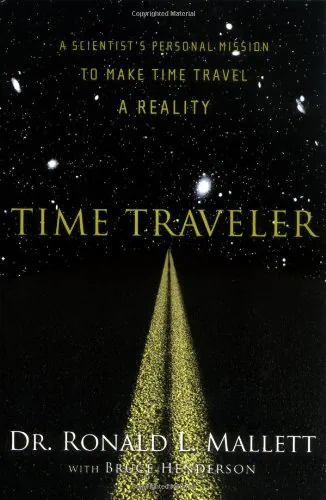
Books by This Guest
Selected titles from the guest bibliography. Use them as context for this appearance, not required listening.
Continue exploring
Paths out of this episode
A stronger next move anchored to this specific broadcast.