The conversation covers Backster's expansion from plants to eggs, bacterial cultures, and human cells, all of which displayed measurable electrical responses to emotional stimuli from nearby living organisms. Backster explains how the communication appears instantaneous and unlimited by distance, aligning with principles of quantum non-locality. He also addresses the challenge of repeatability, noting that plants seem to learn and stop reacting to repeated non-threatening stimuli.
Art and Backster discuss the implications for consciousness research, the Russian replication of his experiments using hypnosis, and how his findings connect to remote viewing and mass intent. The program also features open lines covering topics from nuclear bombs lost at sea to the XPRIZE space competition and RFID chip implants.
Key Moments
The accidental discovery on a Dracaena: Backster recounts how, late one night in 1966, he attached polygraph electrodes to a Dracaena leaf to time water rising through the plant - and instead saw a tracing identical to a human telling a lie.
Burning the leaf - in his mind: Backster describes forming the mere intent to burn the connected leaf with a match. Without speaking, moving, or touching anything, the plant's tracing 'jumped right up to the top of the page.'
Cracking an egg sets the meter on fire: While preparing his Doberman's daily egg, Backster cracked one near a meter wired to a monitored plant. The needle flew into 'wild agitation' - leading him to electrode eggs and discover they react to each other when one is shaken.
Plants learn - and stop reacting: Backster explains why his work is hard to repeat on demand: once a plant has experienced a threat and survived, it ceases to react. Spontaneity, he insists, is the variable critics miss.
Human white cells track their donor across the room: Backster describes harvesting oral leukocytes via saline rinse, wiring them into EEG equipment, and watching the cells' tracings reflect the emotional state of a donor seated elsewhere - work he says was extended to 300 miles.
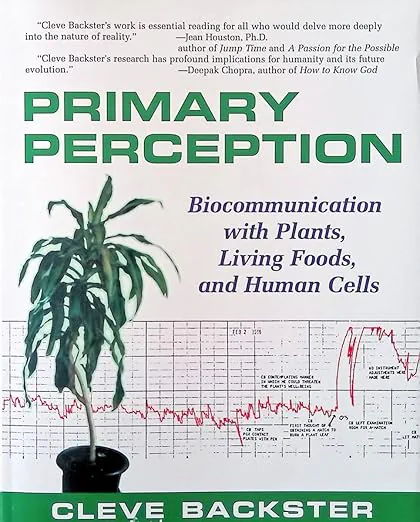
Books by This Guest
Selected titles from the guest bibliography. Use them as context for this appearance, not required listening.