The conversation turns to time travel to the past, where Gott describes his own discovery involving cosmic strings moving at near-light speeds and Kip Thorne's wormhole solutions. He offers a compelling answer to why no time travelers have visited us: no one can use a time machine before it has been built. The pair debate the grandmother paradox, weighing the conservative self-consistent universe model against the many-worlds interpretation of quantum mechanics.
Art presses Gott on whether he would personally take a one-way trip a thousand years into the future. The professor says yes without hesitation, comparing the journey to Marco Polo's 24-year voyage. They also discuss humanity's long-term survival prospects and the importance of colonizing Mars as a species-level insurance policy.
Key Moments
Time travel to the future is already real: Princeton astrophysicist J. Richard Gott explains that traveling forward in time is established physics: at 99.995 percent the speed of light, a 500-light-year round trip would age the traveler 10 years while the Earth ages 1,000. With a 1g laser-light-sail, the trip takes about 24 years subjective time.
Sergei Avdeev, history's greatest time traveler: Gott names Russian cosmonaut Sergei Avdeev as the greatest human time traveler to date - 748 days on Mir aged him about one-fiftieth of a second less than Earth, a measurable Einsteinian effect already confirmed by atomic-clock-on-an-airplane experiments in the 1970s.
Sagan, Kip Thorne, and the wormhole time machine: Gott recounts how Carl Sagan, while writing Contact, asked Caltech physicist Kip Thorne whether wormhole travel was scientifically possible - and Thorne discovered that a properly manipulated wormhole could be turned into a time machine, igniting modern serious physics research into time travel to the past.
Why we're not overrun by tourists from the future: Art asks why, if past time travel is possible, we don't see future visitors. Gott's answer: in both his cosmic-string solution and Thorne's wormhole solution, the time machine cannot be used to travel to any moment before the machine was first built. So a year-3000 machine could only return to 3000, not 2001.
The universe as its own mother: Gott describes his 'self-creating universe' model: inflating universes bud off baby universes in an infinite fractal tree, and one branch can curve back to become the trunk - a tiny time loop at the very beginning, lasting maybe 10^-44 seconds, that lets the universe be its own mother.
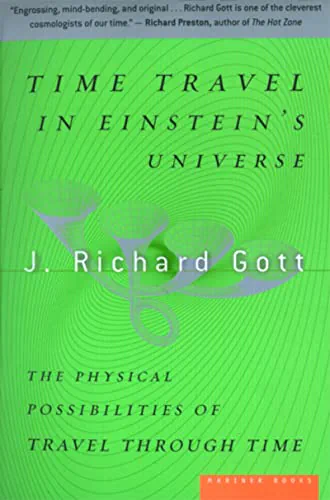
Books by This Guest
Selected titles from the guest bibliography. Use them as context for this appearance, not required listening.