
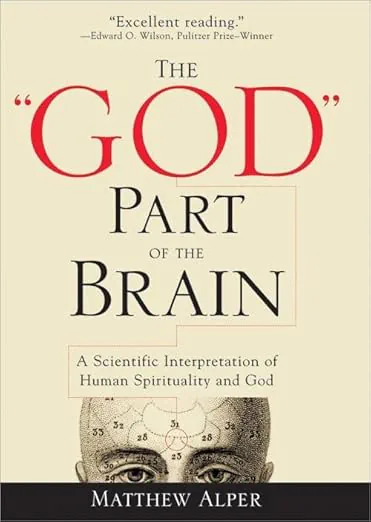
Matthew Alper, author of The God Part of the Brain, presents his theory that human spirituality is a genetically hardwired cognitive function rooted in evolutionary adaptation. He argues that every isolated culture developing spiritual beliefs, burial rituals, and worship points to an inherited neurological trait rather than evidence of an actual spiritual reality. Supporting this are identical twin studies showing 50 percent higher correlation in religious conviction among twins sharing the same genes, and brain imaging research revealing specific neurological changes during prayer and meditation.
Alper contends that self-conscious awareness, humanity's greatest evolutionary advantage, also created an unbearable awareness of mortality. The god part of the brain evolved as a coping mechanism, generating belief in souls, afterlives, and deities to counteract the paralyzing fear of death. Art challenges him on whether a creator might have designed this very neural architecture, and whether prayer studies showing measurable health benefits undermine the purely mechanistic interpretation.
Key Moments
Every culture, no matter how isolated, is spiritual: Alper lays out the sociobiological premise of his theory: every human culture ever studied has prayed to gods, believed in a soul, and buried its dead with afterlife rituals - so spirituality must be part of human genetic makeup.
If man disappears, God disappears: Alper draws the radical conclusion: God is not the creator of man but the manifestation of a cognitive process in human wiring; remove humans and there is no God, no spiritual reality. Art asks 'are you an atheist?' and Alper says yes.
Temporal lobe epileptics shouting 'God is here': Alper recounts Ramachandran's work on temporal-lobe epileptics who tend to be hyper-religious, going into religious ecstasy mid-seizure - falling, weeping, running through streets crying that God is present - localizing religious instinct in the brain.
Persinger's God Helmet: Alper describes Dr. Michael Persinger's transcranial magnetic stimulator - a football-helmet-shaped device that aims a focused magnetic wave at the temporal lobe and reliably makes subjects report feeling the presence of God.
Why we evolved a God part: to keep from going mad: Alper argues the God part of the brain is genetic because without belief in afterlife humans, uniquely aware of their own mortality, would go mad with the fear of death and utter nothingness - so nature selected the wiring that gives us something to look forward to.
Books by This Guest
Selected titles from the guest bibliography. Use them as context for this appearance, not required listening.
Continue exploring
Paths out of this episode
A stronger next move anchored to this specific broadcast.