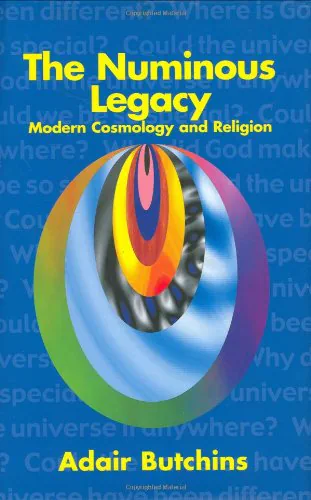
Oxford astrophysicist Adair Butchins joins from London to discuss his book "The Numinous Legacy," which examines how modern cosmology challenges the three great monotheistic religions. Butchins outlines the Copernican principle of mediocrity, arguing that an infinite universe with countless opportunities for life undermines the idea of humanity as uniquely chosen. He presents both the design argument for God and the many-worlds counter-argument, comparing the fine-tuned universe to a gambler hitting the jackpot among infinite possibilities.
Art pushes Butchins to reveal his personal beliefs. Butchins ultimately suggests that if a God exists, it is likely transcendent and indifferent to the universe, more aligned with Aristotle's conception than the interventionist deity of organized religion. He argues that consciousness may arise from a parallel universe that intersects the physical world, carrying with it universal values of ethics and mathematics.
Key Moments
Modern cosmology vs. man-at-the-center religions: Butchins argues Judaism, Christianity and Islam were formulated when humans were the center of the universe; modern cosmology shows the universe is most probably infinite and must contain a lot of intelligent life.
Open vs. closed universe and the big crunch: Butchins explains Einstein's geometry: enough matter density gives a closed, ellipsoidal universe ending in a big crunch; insufficient density yields a saddle-shaped, infinite universe expanding forever - and current data point to acceleration.
Local God vs. lightning-bolt creation: Butchins notes Christian incarnation, the Jewish chosen people, and Islamic heaven and hell all imply a 'local God' that an infinite universe seems to undermine. Art proposes the middle path: a natural process guided by the Lord's hand.
Did the soul evolve alongside free will?: Asked whether the human soul exists, Butchins says biologists like Dawkins reject it, but consciousness and identity remain a mystery; Stannard's view is that a soul could have evolved in concert with free will - and our pets may have one too.
Books by This Guest
Selected titles from the guest bibliography. Use them as context for this appearance, not required listening.
Collection
More in this collection
Continue exploring
Paths out of this episode
A stronger next move anchored to this specific broadcast.