Episode 0956 · May 16, 2002 · 2h 52m
May 16, 2002: UFO Crash Video, Climate Change - Stan Deyo | What if the Big Bang Theory is Wrong - Dr. Paul Steinhardt
Key Moments
Open transcriptStan Deyo reads the UFO crash videoListening live as Art Bell and Stan Deyo dissect a mysterious crash video posted minutes before airtime, Deyo identifies an inverted electric-field cone, a magnesium-style flare and a rock-skip second impact.
Predicting Japan earthquake from sea-surface anomaliesDeyo explains how OTIS thermal maps and seawater-weight changes give a 36-72 hour earthquake warning, and announces a fresh signature has just appeared under Japan.
Steinhardtit's the Big Stretch, not the Big Bang: Princeton's Albert Einstein Professor pushes back on the popular picture, telling Art the Big Bang has no center and is better described as space itself stretching uniformly like an infinite rubber sheet.
Dark energy and a self-repulsive universeSteinhardt walks through the recent discovery that cosmic expansion is accelerating, introducing dark energy as a gravitationally self-repulsive form of energy with negative pressure.
The cyclic universebangs without end: Steinhardt lays out his cyclic model where the Bang repeats endlessly, Earth would be vaporized in the next ignition, and a far-future civilization would see gravity itself begin to change as warning.
In the second half, Princeton theoretical physicist Paul Steinhardt introduces his cyclic model of the universe, a radical alternative to the standard Big Bang theory. Rather than a singular beginning, Steinhardt proposes the universe undergoes repeating cycles of creation and destruction over trillions of years, with dark energy driving accelerating expansion between each cycle. He explains how gravity depends not just on mass but also on pressure and energy, and how dark energy produces a gravitational repulsion that could theoretically be harnessed.
Art presses Steinhardt on the implications for extraterrestrial life, faster-than-light travel, and whether civilizations surviving previous cycles would appear godlike to us. Steinhardt cautions that the vastness of space may keep intelligent species permanently isolated regardless of their technological advancement.
Preserved source
From the original ArtBell.com archive
The 2003 commemorative archive preserves the contemporary listing for this broadcast. Links and descriptions reflect the original site and may be outdated.
View the original program listingImages and material referenced by the original site
Guest Library
Books by These Guests
Selected titles from the guest bibliography. Use them as context for this appearance, not required listening.
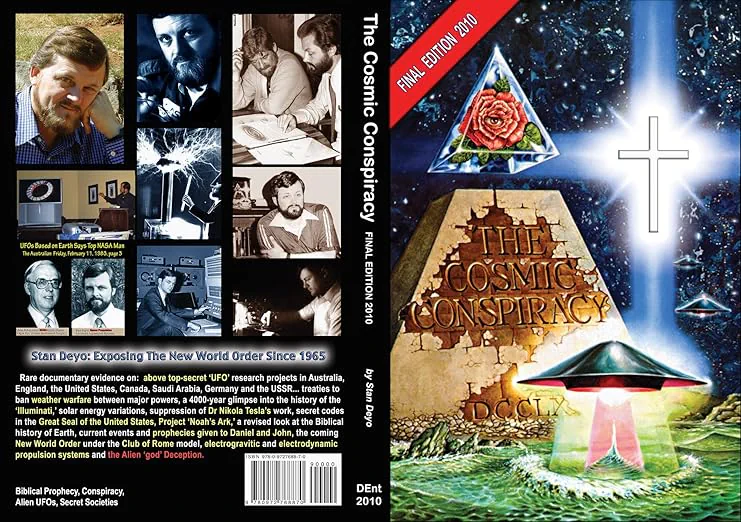

The Vindicator Scrolls


Quasicrystals: The State of the Art

The Physics of Quasicrystals
Continue exploring