Lanza walks through landmark experiments including the double-slit test, Heisenberg's Uncertainty Principle, and entangled particles that communicate instantaneously across vast distances. He explains that space and time are not external objects but tools of the mind, frameworks through which consciousness constructs experience. He cites a study published in Science demonstrating that a present-moment decision can retroactively alter a past event, supporting the idea that the observer plays an active role in shaping reality.
The discussion expands into the future implications of understanding consciousness at this level. Lanza suggests that once science decodes the algorithms behind how the mind builds space and time, humanity could construct entirely new realities operating on different dimensional rules, potentially allowing consciousness to move through the multiverse as freely as walking through a room.
Key Moments
Without an observer there is no reality: Lanza's headline biocentrism claim: matter depends on the observer for its properties, so a universe without conscious life cannot exist.
Two-slit experiment as proof: Lanza walks Art through the double-slit experiment, where particles act like bullets when watched and like waves when unobserved, as evidence that observation creates reality.
Choices today change the past: Citing John Wheeler's delayed-choice work with quasar light, Lanza argues that present-day measurements determine the path light took billions of years ago.
Walking through time like space: Lanza speculates that once we crack the algorithms of consciousness we could rewrite time as a three-dimensional axis and move through it the way we walk through a room.
Death does not exist: Lanza argues that because energy is never destroyed and life unfolds across a multiverse, the self does not end at biological death - it continues across other resulting universes.
Books by This Guest
Selected titles from the guest bibliography. Use them as context for this appearance, not required listening.
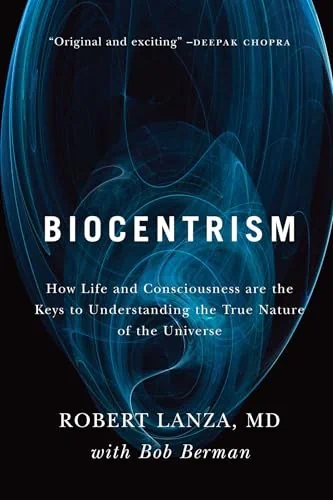
Biocentrism: How Life and Consciousness are the Keys to Understanding the True Nature of the Universe
2009
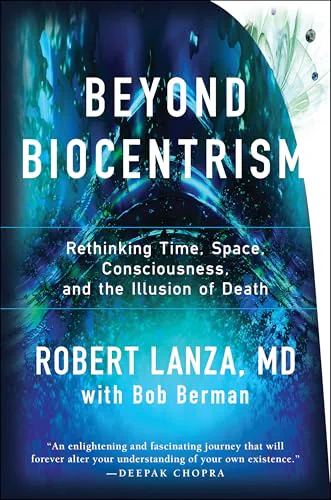
Beyond Biocentrism: Rethinking Time, Space, Consciousness, and the Illusion of Death
2016