
March 13, 2001: Ancient Cosmology - Dr. Richard L. Thompson
Dr. Thompson presents findings from his book Mysteries of the Sacred Universe, revealing that an ancient Indian text appearing to describe a flat earth actually contains an accurate map of the solar system. The planetary orbit dimensions encoded in the text match modern astronomical data with odds of roughly one in 20,000 of occurring by chance. He connects these measurements to ancient Egyptian units of length that correspond precisely to subdivisions of latitude, suggesting both civilizations shared advanced geodetic knowledge.
The discussion expands to evidence of cyclical rises and falls of civilization, the planetary alignment on the traditional flood date of February 18, 3102 BC, and ancient Indian literature describing flying machines and hydraulic automata such as automatic door openers. Thompson argues that dark ages caused by climate change or drought periodically destroyed the institutional frameworks needed to preserve scientific knowledge, leaving only fragmentary traces behind.
Key Moments
Why no high-tech debris from a lost civilization: Responding to a listener who asks where the titanium tools and steel girders are from any allegedly advanced ancient society, Thompson concedes the point, then argues their knowledge may have come without our kind of high-tech infrastructure - comparing to Tycho Brahe deducing Kepler's laws by naked-eye observation.
The flat-earth cosmology was actually the solar system: Thompson explains that the universal ancient flat-earth cosmology - Mount Meru at center, four rivers at right angles, a tree of life - turns out, on closer reading, to be a description of the solar system. The same diagram shows up in India, North American tribes, Africa, and ancient Europe.
Vedic time scales align with geological time: A caller asks whether Thompson, as a Krishna-affiliated researcher, makes common cause with young-earth Christian creationists. Thompson distinguishes himself: the Vedic day of Brahma is over four billion years long, broadly compatible with the geological timescale, though the events within it differ.
Vimanaka Shastra and the alloy that absorbs light: Thompson tells the story of Subbaraya Shastri, an uneducated village boy who entered trances and dictated whole texts in archaic Sanskrit - including a treatise on building Vimanas (ancient flying craft). An engineer translated metal-alloy formulas from it and produced a real alloy that strongly absorbs laser light, like stealth coating.
Channeling archaic Sanskrit defies fakery: Thompson concedes skepticism about channeling generally but argues this case is unusual: Subbaraya Shastri spoke fluent Sanskrit he'd never studied, and not modern Sanskrit but archaic Sanskrit. Even if he secretly studied to fake it, learning archaic forms is essentially impossible.
Preserved source
From the original ArtBell.com archive
The 2003 commemorative archive preserves the contemporary listing for this broadcast. Links and descriptions reflect the original site and may be outdated.
View the original program listingBooks by This Guest
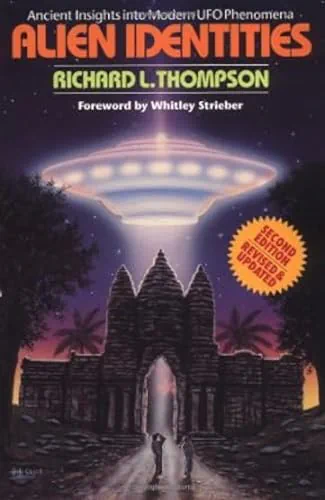
Selected titles from the guest bibliography. Use them as context for this appearance, not required listening.
Collection
More in this collection
Continue exploring
Paths out of this episode
A stronger next move anchored to this specific broadcast.