Baumann describes how his journey toward spirituality began when he pronounced a patient dead only to have them revive 30 minutes later. He discusses Raymond Moody's near-death experience research and shares accounts of patients returning from clinical death angry at being resuscitated, having experienced profound peace on the other side.
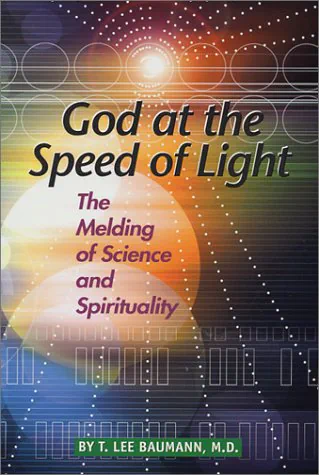
The core of the interview centers on Baumann's thesis that God and light are literally connected, not merely metaphorically. He explains the double-slit experiment, in which light appeared to alter its behavior before reaching modified endpoints, suggesting an awareness that physicists themselves described using the word consciousness. Baumann argues that since time stops at the speed of light, as Einstein proved, light operates outside the boundaries of time, placing it in a realm consistent with how every major world religion has described the divine.
Key Moments
The patient pronounced dead, then alert thirty minutes later: Internist Lee Baumann recounts a Harrisburg residency case where he carefully pronounced a patient dead, only to be called back thirty minutes later because the patient was alert and talking - his first encounter with the limits of clinical death.
Why every religion describes God as light: Baumann's eureka thesis: Einstein's relativity makes light the cornerstone of physics, near-death experiencers meet a being of light, and every major scripture describes God in terms of light - he argues these are not metaphors but literal.
The double-slit experiment: light has no time: Baumann walks Bell through the modified double-slit experiment, where photons appear to alter their behavior before reaching a downstream change, and explains it via Einstein and muons: time does not exist for light.
Schroeder's universal days and the Cambrian explosion: Baumann presents Schroeder's halving-time 'universal days' that fit Genesis to 15.75 billion years, then argues the 5-10 million year Cambrian explosion is impossible under Darwinian models that demand hundreds of millions of years.
John Lear's warning: don't go to the light: Bell drops a haunting John Lear claim - that the dying are tricked into 'going to the light' and should instead go toward the darkness - and Baumann counters with cases where hellish NDEs ended the moment the experiencer cried out for God and the light arrived.
Books by This Guest
Selected titles from the guest bibliography. Use them as context for this appearance, not required listening.