Seife describes the theoretical scenario known as the Big Rip, in which dark energy grows so dominant that it tears apart galaxies, solar systems, planets, and eventually atoms themselves, leaving nothing but lifeless radiation. He discusses zero-point energy, the force generated by particles and antiparticles constantly being created and destroyed in the vacuum of space, noting that a toaster-sized volume theoretically contains more energy than all nuclear arsenals combined. Despite this, he explains, the energy appears impossible to harness.
The discussion moves to parallel universes, the ecpyrotic theory of colliding dimensional membranes, and the mathematical proof that infinities come in different sizes. Art presses Seife on why most scientists reject the existence of God, and Seife responds that science simply runs out of explanatory power at its boundaries, leaving both belief and disbelief as matters of where one places the mystery.
Key Moments
We are living through dark energy taking over: Seife says the past seven years of evidence for dark energy place us right at the inflection point where the anti-gravity force begins to dominate gravity, making cosmic expansion accelerate.
The Big Rip - hours from galaxies to atoms: Seife describes Mark Kamionkowski's 'Big Rip' scenario: if dark energy strengthens, galaxies, solar systems, planets, and finally atoms come apart in a cascade ending in a soup of lifeless radiation - the final stages playing out in hours.
Einstein's biggest blunder turned out to be right: Seife traces dark energy back to the cosmological constant Einstein added in the 1920s and later disowned, showing how late-90s supernova standard-candle observations forced scientists to resurrect it against their will.
Two membranes colliding - the ekpyrotic Big Bang: As an alternative to 'something from nothing,' Seife introduces the ekpyrotic theory grounded in M-theory: two parallel-universe membranes periodically collide, and each collision produces what we experience as a Big Bang.
The anthropic principle and the unanswerable: Seife explains why fine-tuning bothers scientists: the anthropic principle says the universe must permit life because we are here to ask, but it is unsatisfying, the many-worlds option sounds silly, and this may be permanently unanswerable.
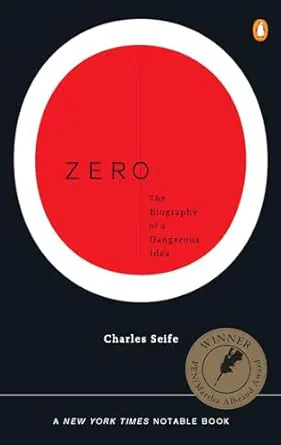
Books by This Guest
Selected titles from the guest bibliography. Use them as context for this appearance, not required listening.
Collection
More in this collection
Continue exploring
Paths out of this episode
Stronger next moves anchored to this specific broadcast.