The two spar over interstellar travel feasibility, with Art raising points from nuclear physicist Stanton Friedman about energy requirements and trip profiles. Shostak acknowledges that fewer than a thousand star systems have been carefully examined so far, a tiny fraction of the hundreds of billions in our galaxy. He describes SETI's new telescopes and methods while maintaining his skepticism about current visitation claims. Art challenges him with recent UFO sightings from O'Hare Airport and North London, where dozens of witnesses reported silent objects hovering in formation.
The first hour features open lines touching on the landmark UN climate change report, ExxonMobil's offer of $10,000 to scientists willing to critique its findings, the Bush administration's suppression of climate terminology, Edgar Cayce, and Art's visit to Bigelow Aerospace via helicopter.
Key Moments
Fewer than 1,000 stars deeply searched: Shostak admits the entire sky has been surveyed only at low sensitivity; fewer than a thousand individual star systems have been carefully examined for signals.
Allen Telescope Array bet: Shostak describes the 350-antenna Allen Telescope Array, explains why electronics getting cheap shifted the design paradigm, and bets a cup of coffee SETI will succeed within two dozen years.
Life began as soon as Earth could host it: Shostak: fossils show life appeared roughly the moment Earth became habitable - like winning a Vegas jackpot on the first pull, suggesting life is probable wherever conditions allow.
Skeptical of Star Trek 'prime directive': Shostak rejects the assumption that visiting aliens would politely observe us; in human history it's the aggressive explorers who travel - Spaniards wiping out Aztecs, not gentle observers.
How SETI rules out spy satellites: Shostak walks through how SETI distinguishes ET from classified DOD satellites - the Doppler shift of a 90-minute orbit gives a fast frequency drift, unlike a fixed-distance star.
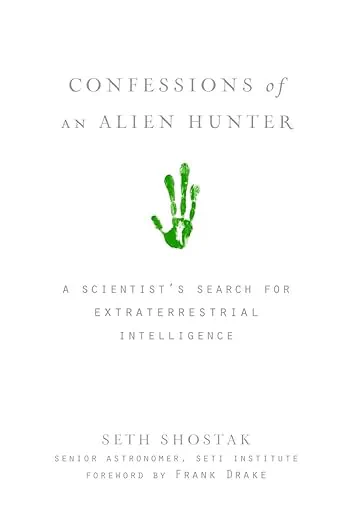
Books by This Guest
Selected titles from the guest bibliography. Use them as context for this appearance, not required listening.
Continue exploring
Paths out of this episode
A stronger next move anchored to this specific broadcast.