
The conversation turns to the risks of self-replicating nanobots, the so-called gray goo scenario popularized by Eric Drexler. Mulhall argues the greater danger lies not in runaway machines but in the economic disruption caused by desktop manufacturing that could make entire industries obsolete overnight. He describes how molecular fabrication would eliminate scarcity of most physical goods, potentially destabilizing economies built on resource extraction and mass production.
Art presses Mulhall on the implications for medicine, and Mulhall describes nanoscale devices already being tested that can deliver drugs directly to cancer cells, repair damaged tissue from the inside, and eventually reverse the aging process at the cellular level. The discussion also covers quantum computing, the challenge of programming machines that operate at the atomic scale, and whether nanotechnology could provide the clean energy breakthrough needed to avert a global resource crisis.
Key Moments
$127 Billion for Silicon Soldiers: Art reads from an editorial about the Pentagon's Future Combat Systems Project spending $127 billion to create artificial intelligence warriors, asking whether wars without American casualties will be more alluring or chilling.
Two Talented People in a Small Room: Mulhall contrasts nanotechnology with nuclear weapons: where nukes need vast energy and infrastructure, nanotech can be developed by two or three talented people in a very small room and brought to market.
DARPA's Smart Dust Robots: Mulhall describes DARPA-funded smart dust: robots so small with onboard cameras, propulsion, and communications that they are lighter than air and float like dust. He says the drones flying over Iraq are just big versions of these.
Borg Versus Branching: Two Futures: Mulhall lays out the two visions for human-machine convergence: the Borg of total control over everyone, or a rapid branching of the human species into varying combinations of artificial and human intelligence. He cites optobionic eye implants happening now.
Gray Goo Cannot Be Stopped: Asked whether the inventors worry at night, Mulhall says the work is breaking out simultaneously in Toronto, Oxford, Berkeley, and Silicon Valley, and you'd have to shut down the military to stop it. Art presses: gray goo is technically plausible, all that's needed is somebody willing to give their life to kill a lot of people.
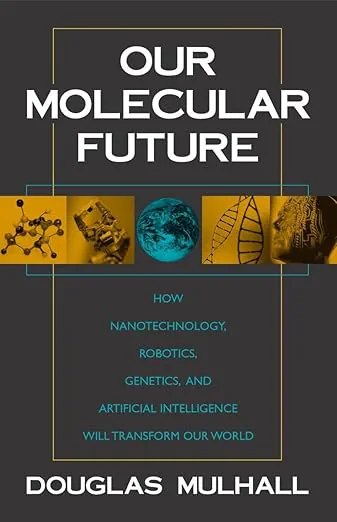
Books by This Guest
Selected titles from the guest bibliography. Use them as context for this appearance, not required listening.
Continue exploring
Paths out of this episode
A stronger next move anchored to this specific broadcast.