Shostak explains that the system monitors 28 million frequency channels simultaneously, scanning nearby stars for artificial signals. He describes the Arecibo dish as 18 acres of aluminum panels with 70 decibels of gain, capable of detecting a 20,000-watt transmitter from hundreds of light-years away. Art asks why humanity does not actively transmit, and Shostak outlines the diplomatic concerns, the impracticality of waiting thousands of years for a reply, and the reasoning that older civilizations should bear the burden of signaling.
The conversation also addresses a recent book arguing Earth may harbor the only complex life in the universe. Shostak pushes back on this thesis, noting that only 500 of the galaxy's 500 billion stars have been examined so far. He describes plans for a dedicated telescope capable of surveying a million stars, a threshold where detection becomes statistically meaningful.
Key Moments
Why the world's biggest dish sits in a Puerto Rican sinkhole: Shostak explains how a pilot flying over Puerto Rico's karst topography 40 years earlier spotted a near-perfect natural bowl that, draped in mesh, became Arecibo -- the 18-acre, 26-football-field aluminum-paneled radio mirror dropped into a limestone sinkhole.
Arecibo's 70 dB gain: a 1-watt radio becomes 10 million: Shostak walks Bell, a ham radio operator, through Arecibo's 70 dB of gain at hydrogen-line microwave frequencies -- a one-watt transmitter behaves like 10 million watts radiated in a beam, and a 100,000-watt feed would equate to 10 billion watts.
The 1974 Arecibo message and what an ET signal would look like: Shostak describes the 1974 Arecibo bitmap -- around 1,679 bits picturing our solar system, a stick-figure human, and DNA -- and assures Bell any reciprocal alien signal would be unmistakably artificial, distinct from pulsars or quasars.
Shostak on the 10% of UFO sightings that go unexplained: Pressed by Bell on NORAD-grade sightings, Shostak grants that roughly 90% of investigated UFO reports get mundane explanations and 10% don't -- but argues, like New York's unsolved murders, that 'unexplained' isn't evidence for aliens, and that nobody has yet walked into the SETI Institute with a UFO bumper.
Why a SETI detection would be self-checking: Shostak frames SETI's epistemic edge: unlike a UFO sighting, a positive detection isn't about competing interpretations -- anyone with a big antenna could verify the signal, making it a true scientific experiment with a falsifiable claim of success.
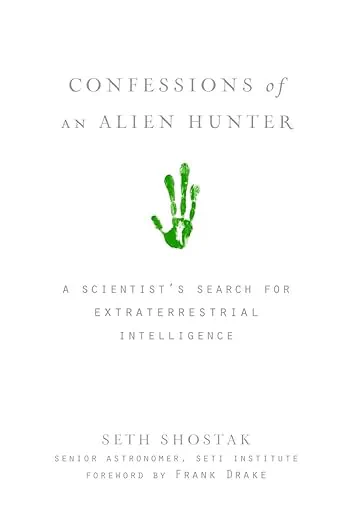
Books by This Guest
Selected titles from the guest bibliography. Use them as context for this appearance, not required listening.
Continue exploring
Paths out of this episode
A stronger next move anchored to this specific broadcast.