The conversation covers the Big Bang, the space-time theorem of general relativity, and the biblical claim that the creator operates beyond ten space-time dimensions. Dr. Ross argues that the fine-tuning of the universe points to intelligent design, while Dr. Rana describes how the specified complexity inside living cells convinced him that natural processes alone cannot account for the origin of life.
Art challenges his guests with questions about prayer studies, the "God Part of the Brain" hypothesis, extraterrestrial life, and macroevolution. The doctors field calls from listeners asking about the fossil record, human evolution, genetic similarities between species, and the nephilim. Throughout, both scientists maintain that physical evidence overwhelmingly supports the existence of a purposeful creator behind the cosmos.
Key Moments
Cause beyond space-time: Ross explains that general relativity's space-time theorem implies a cause independent of matter, energy, space, and time must exist to bring the universe into being.
Ten dimensions and a multi-time God: Ross argues the Bible uniquely describes a creator operating in dimensions beyond length, width, height and time, consistent with string theory's ten space-time dimensions.
14.5 billion year universe: Ross dates the Big Bang to 14.5 billion years ago and aligns himself with mainstream cosmology rather than young-earth creationism.
100 billion trillion stars for one Earth: Ross counters Sagan's 'awful waste of space' line by arguing the universe needs precisely 10^23 stars to produce the carbon, oxygen and nitrogen required for one habitable Earth.
Odds against another habitable planet: Ross cites a probability calculation of less than 1 in 10^120 of finding any other planet capable of supporting physical life, against a maximum of 10^22 candidate planets.
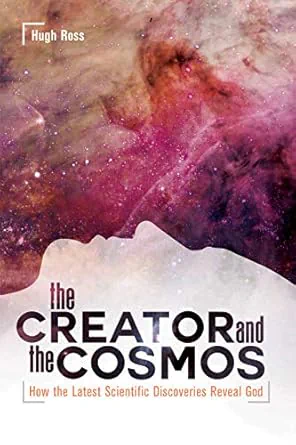
Books by This Guest
Selected titles from the guest bibliography. Use them as context for this appearance, not required listening.