
The conversation moves from narrow capabilities to existential questions. Hutter estimates self-aware AI roughly 30 years away and lays out paths: machines viewing humans as threats, cyborgification where brains atrophy as function transfers to implants, or consciousness uploaded into simulation. He argues consciousness emerges from information processing, using the neuron replacement thought experiment: swap neurons one by one for artificial equivalents and consciousness never disappears. Art Bell asks whether a digitized brain would need sleep. Hutter says yes, since the brain performs essential processing during rest a simulation would replicate. He suggests lawyers may be among the next professionals displaced, since legal work relies on knowledge bases and rules computers handle naturally.
An episode where the math behind artificial intelligence meets the question of what it means to be conscious.
Key Moments
True AI is 20 to 30 years away: Hutter offers his timeline estimate for human-level artificial general intelligence and says it is unclear whether versatile robots or superintelligent algorithms will arrive first.
How do I know YOU are self-aware?: Asked whether AI could ever become self-aware, Hutter flips the question on Art, asking how he can be sure Art himself is self-aware and not a machine pretending to be.
The Hutter Prize: compression equals intelligence: Hutter explains his 50,000 euro Human Knowledge Compression Contest, where beating the existing Wikipedia compression record by a percentage earns the same percentage of the prize, on the theory that better compression equals better understanding.
Raising AI like a child so it values human life: Hutter describes the reinforcement-learning approach to AI safety, raising a blank-slate AI in a human environment with carrot and stick rewards, hoping that, like a child, it will value human life rather than kill us once it surpasses us.
Books by This Guest
Selected titles from the guest bibliography. Use them as context for this appearance, not required listening.
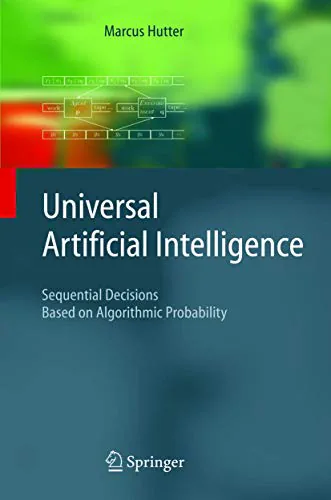
Universal Artificial Intelligence: Sequential Decisions Based on Algorithmic Probability
2004