The conversation turns to the theoretical possibility of traveling backward in time through exotic constructs like wormholes, which would require gravitationally repulsive material unlike anything observed in nature. Krauss walks through the mechanics of how a traversable wormhole could function as a time machine, while acknowledging the staggering energy requirements involved. He also addresses the grandmother paradox and its limited proposed solutions, including the unsatisfying causality loop.
Art and Krauss explore the Big Bang, tracing the universe back to a point smaller than a baseball, and discuss the evidence supporting cosmological theory through precise predictions of elemental abundances. They also touch on the likelihood of extraterrestrial life, the multiverse concept, and why interstellar travel remains practically impossible given current physics. The first hour features open lines on implantable microchips, the biblical Mark of the Beast, and Buddhist perspectives on ghosts.
Key Moments
Backward time travel needs negative energy: Krauss explains that simply slowing or speeding clocks isn't enough to travel into the past; you need exotic, gravitationally repulsive 'negative energy' that we have no proven way to make.
How a wormhole becomes a time machine: Using the Jodie Foster 'Contact' image, Krauss walks Bell through wormholes as space-time shortcuts and shows how moving one mouth near light speed leaves an observer five years behind in time.
Everything we see, once smaller than a baseball: Krauss insists colliders are not 'recreating the Big Bang' and pivots to the staggering claim that all visible mass and energy was once compressed into a region smaller than a baseball, illustrated by neutron-star collapse.
Big Bang predictions confirmed to ten orders of magnitude: Krauss lays out the evidence for the hot Big Bang: predicted helium and lithium abundances and the 1965 discovery of the cosmic microwave background, all matching observations to extraordinary precision.
Why interstellar visitors are extremely unlikely: Krauss argues life elsewhere is plausible, but UFO visitation is not: near-light-speed travel demands the energy of a star, and radio is a vastly more efficient way for any civilization to make first contact.
Books by This Guest
Selected titles from the guest bibliography. Use them as context for this appearance, not required listening.
Atom: A Single Oxygen Atom's Journey from the Big Bang to Life on Earth...and Beyond
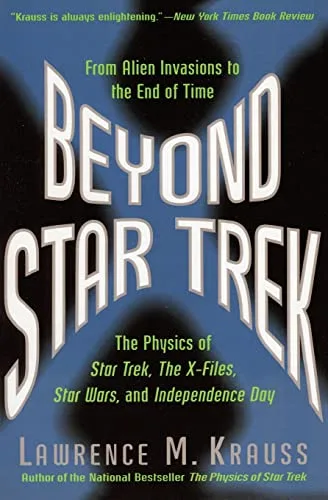
Beyond Star Trek: Physics from Alien Invasions to the End of Time
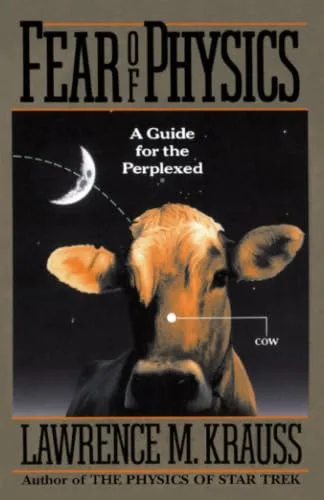
Fear of Physics: A Guide for the Perplexed
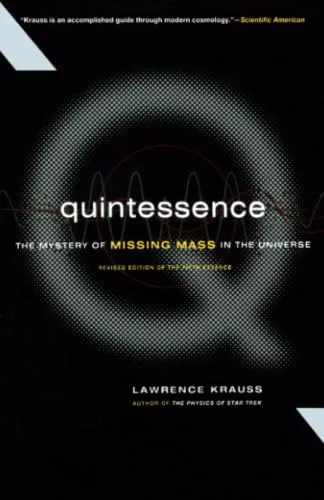
Quintessence: The Mystery of the Missing Mass