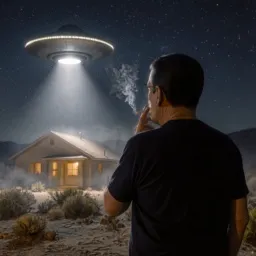
November 16, 1997: Lights over the Northwest (Partial) - Linda Moulton Howe
NORAD confirms they tracked a Russian SL-12 rocket body launched November 12th, saying it broke apart over Vancouver. Reports of booms and shuddering walls in Abbotsford, British Columbia, along with newspaper accounts of debris falling in the suburb of Burnaby, support this explanation for the western sightings. However, NORAD acknowledges they cannot account for reports further east.
Howe presents witness testimony from Tenasket, Washington, describing red lights flying in formation, and from Sandpoint, Idaho, where seven stationary glowing globes hovered silently for up to ten minutes before vanishing instantaneously. She concludes that the events of November 14th involved more than a single Russian rocket reentry, with multiple unexplained phenomena occurring simultaneously across several states.
Key Moments
Henriksen RASC: counted 36 pieces, 45-second breakup: Ken Henriksen, president of the Royal Astronomical Society of Canada in Vancouver and a 400-hour sky-gazer, tells Howe it was '100% not a meteor storm' - he counted 36 discrete pieces over a 45-second post-breakup descent, white with diamond-dust streamers on black felt.
Why it wasn't a bolide: too slow, too low: Henriksen rules out a bolide: a body deep enough in the atmosphere to be seen this close should last 3-10 seconds, not over a minute. The object decelerated as it broke up, consistent with something already in low Earth orbit hitting friction.
Sandpoint, Idaho: seven stationary lights in 4-3 formation: Marty Kellogg in Sandpoint, Idaho - well east of the SL-12 track - describes seven huge stationary lights at the same hour: four on top in a straight line, three below filling the gaps, with one emitting separate translucent blue, red, and green beams. They didn't move; they vanished as if a switch was thrown.
Preserved source
From the original ArtBell.com archive
The 2003 commemorative archive preserves the contemporary listing for this broadcast. Links and descriptions reflect the original site and may be outdated.
View the original program listingBooks by This Guest
Selected titles from the guest bibliography. Use them as context for this appearance, not required listening.
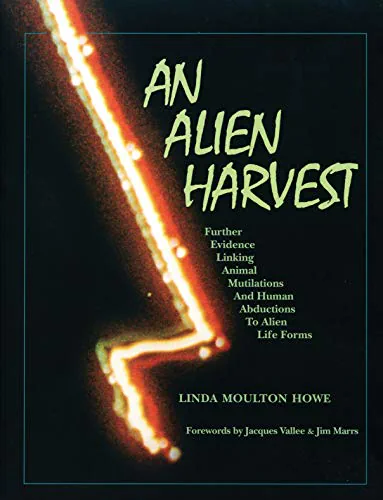
An Alien Harvest: Further Evidence Linking Animal Mutilations and Human Abductions to Alien Life Forms
1989
Continue exploring
Paths out of this episode
A stronger next move anchored to this specific broadcast.