The discussion moves into the strange world of quantum mechanics, where the rules governing subatomic particles differ fundamentally from everyday experience. Greene describes how electrons behave probabilistically rather than predictably, and how quantum entanglement allows separated particles to correlate their behavior instantaneously across vast distances, challenging our deepest assumptions about the nature of reality.
Art and Greene explore time travel, with Greene confirming that travel to the future is fully permitted by Einstein's equations, while travel to the past remains an open question. They also discuss the potential of quantum computers to perform calculations exponentially faster than current machines, possibly even giving rise to artificial intelligence that surpasses human cognition.
Key Moments
Without Einstein, would we still have the bomb?: Greene argues E=mc^2 made the atomic bomb possible, but says even without Einstein, others were already on the trail of relativity and we would still have nuclear weapons today.
Rocket-ship time travel to the future is real physics: Greene walks Art through the twin-paradox scenario: a traveler near light speed for a year returns to find Earth aged ten, a thousand, even a million years. Time travel to the future is allowed by physics; we just can't build the ship.
Past, present, and future all exist equally: Greene tells Art that the division of time into past, present, and future is an illusion. All moments exist on equal footing, and observers in motion don't even agree on what 'now' is.
Why we haven't met time travelers from the future: Greene's answer to Art's classic question: every proposed time machine can only reach back as far as the moment the first machine was switched on. We haven't built one yet, so future travelers can't reach 2005.
String theory in plain English: Greene zooms inside quarks and electrons to describe tiny vibrating filaments of energy. Different vibration patterns of one kind of string produce every different particle in nature, like notes from a violin string.
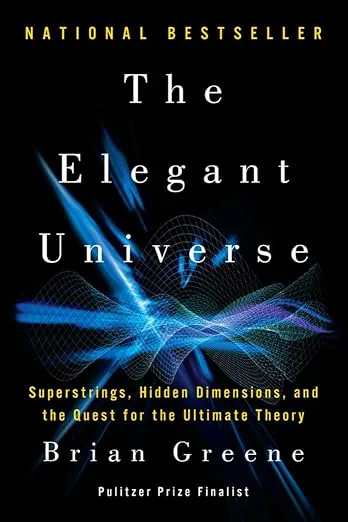
Books by This Guest
Selected titles from the guest bibliography. Use them as context for this appearance, not required listening.
Continue exploring
Paths out of this episode
A stronger next move anchored to this specific broadcast.