
The conversation shifts to the growing tensions between NASA's bureaucratic culture and the emerging private space industry. Zimmerman argues that SpaceShipOne's successful suborbital flights represent a paradigm shift, proving that small entrepreneurial teams can achieve what previously required government-scale budgets. He criticizes NASA's Constellation program as overly expensive and politically driven, predicting that private companies will eventually surpass the agency in both innovation and cost efficiency.
Art and Zimmerman discuss the European Space Agency's Huygens probe landing on Saturn's moon Titan, which revealed a frozen landscape with methane rivers and hydrocarbon rain. They examine whether the Bush administration's vision for a return to the Moon and eventual Mars missions is realistic given current funding levels. Zimmerman expresses concern that political promises without adequate budgets will repeat the pattern of Apollo, where capabilities were built and then abandoned within a single generation.
Key Moments
Private Space: XPRIZE, Bigelow, and Musk's Falcon: Zimmerman lays out the new private space landscape: the XPRIZE, Bigelow's America's Prize demanding an orbital mission this decade, Bigelow's already-built habitat modules ready for a cheap launcher, and Elon Musk's Falcon rocket aiming to take the rocket industry back from the Russians.
Private Industry Will Wave Goodbye to NASA: Zimmerman says he has serious doubts NASA can pull off the Bush return-to-the-moon plan and predicts that by 2010 private American industry will be in a position to wave goodbye to NASA as they head off to the moon.
If Russia or China Plants the Flag First: Zimmerman says competition is gearing up and a foreign first to the Moon could trigger another Sputnik moment. He thinks Russia is more likely to surprise the US than China because of their existing knowledge, experience, and infrastructure. He notes Apollo 11's flag was knocked over by the LEM ascent in 1969.
James Webb Will Not Replace Hubble: Zimmerman flatly states anyone who claims the James Webb Telescope will replace Hubble is lying because Webb is infrared-only and Hubble covers ultraviolet to infrared. He says Congress allocated $300 million for a Hubble servicing mission, and it is NASA, not Congress, that wants to drop the rescue.
NASA Doesn't Have the Right Stuff: Asked why NASA refuses to service Hubble, Zimmerman answers Fear, fear of astronauts dying. He cites acting administrator Fred Gregory's absolute safety testimony and compares the shuttle's under-2 percent loss rate favorably to the Clipper ships' routine 5 percent annual loss.
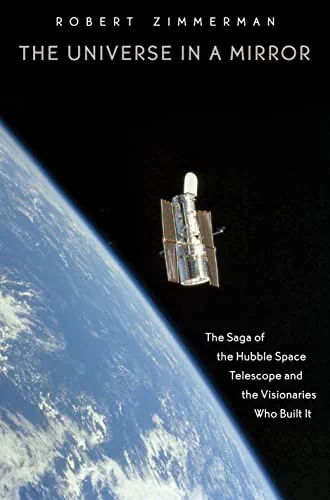
Books by This Guest
Selected titles from the guest bibliography. Use them as context for this appearance, not required listening.

Continue exploring
Paths out of this episode
A stronger next move anchored to this specific broadcast.