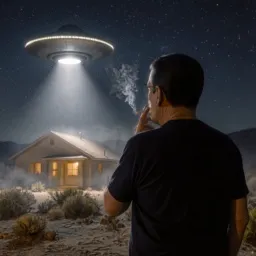
The conversation covers the science behind choosing optimal listening frequencies, particularly the "waterhole" region between the hydrogen and hydroxyl spectral lines at 1.3 to 1.7 gigahertz. Dr. Shuch details how the SETI League's Project Argus aims to do what even NASA could not afford, organizing a grassroots all-sky survey using hundreds of volunteer-operated stations worldwide to complement the SETI Institute's targeted search.
Art and Dr. Shuch share their common roots in early satellite television, bond over ham radio, and walk listeners through the surprisingly affordable equipment needed to join the search. The episode also touches on the Monica Lewinsky interview, military urban warfare exercises, and reports of mysterious contrails over the San Fernando Valley.
Key Moments
Why we probably can't decode alien TV leakage: Shuch explains that incidental Earth-like radio and TV leakage is unlikely to be decodable across light years; the best hope is detecting a signal whose artificial hallmarks prove an intelligence is behind it, not extracting a message.
Pauses for breath: our most detectable interstellar signature: Shuch notes that during normal speech the FM carrier spreads across sidebands too wide to detect, but every pause for breath collapses the power onto a single carrier frequency, which is the strongest interstellar signature broadcast civilizations actually emit.
Cold War radars and the great filter: Shuch explains that humanity's most detectable signals were Cold War over-the-horizon search radars like the Soviet Woodpecker, and physicists worry few civilizations survive past the discovery of element 92 (uranium) - a sobering Fermi-paradox framing.
Preserved source
From the original ArtBell.com archive
The 2003 commemorative archive preserves the contemporary listing for this broadcast. Links and descriptions reflect the original site and may be outdated.
View the original program listingBooks by This Guest
Selected titles from the guest bibliography. Use them as context for this appearance, not required listening.
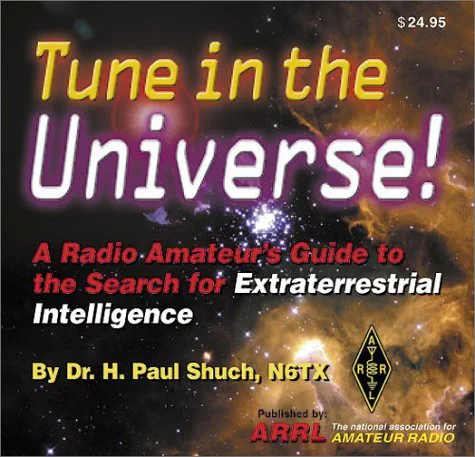
Tune in the Universe: A Radio Amateur's Guide to the Search for Extraterrestrial Intelligence
2001
Continue exploring
Paths out of this episode
A stronger next move anchored to this specific broadcast.