Cook explains how his research into antigravity led him to zero-point energy, the theoretical energy present in the quantum vacuum of empty space. He describes experiments by Russian physicist Evgeny Podkletnov, whose work with superconductors produced a measurable three-percent weight loss that should be impossible under conventional physics. While NASA failed to replicate the result before funding was cut, Cook notes that Aviation Week and Space Technology has begun reporting on zero-point energy as a potential deep-space propulsion source.
The conversation connects these threads to Nikola Tesla's pioneering work over a century ago and the FBI's seizure of his papers after his death. Cook and Art discuss the urgent need for new energy sources as fossil fuel supplies dwindle and environmental damage accelerates, with Cook expressing confidence that real science underpins these seemingly heretical physics.
Key Moments
Podkletnov's superconductor weight loss: Cook says his ten-year search proved antigravity is possible - citing Russian Evgeny Podkletnov's experiment where a weight dangled above a spinning superconductor lost about 3% of its weight, with theoretical backing from physicist Giovanni Modernese.
Aviation Week now covers zero-point: Cook notes Aviation Week & Space Technology - the foremost U.S. aerospace journal - has begun reporting on zero-point energy as a possible deep-space propulsion source 50–100 years out, validating his earlier reporting.
Tesla's century-old work being verified: Asked if zero-point research will catch up to Tesla, Cook says yes - 100 years on, the science Tesla did 'will be verified by the physics of the zero point energy field' after a century in which it was 'completely forgotten.'
FBI seized Tesla's papers when he died: Cook confirms Art's claim that the FBI moved on Tesla's apartment at his death and classified his materials, suggesting wartime-era authorities feared the work was 'interesting and perhaps dangerous.'
Antigravity trail leads back to Nazi science: Cook says when he investigated antigravity, the data 'continued to take me back to the Second World War,' revealing a tangible connection between German wartime science and zero-point/antigravity research that was missing from mainstream history books.
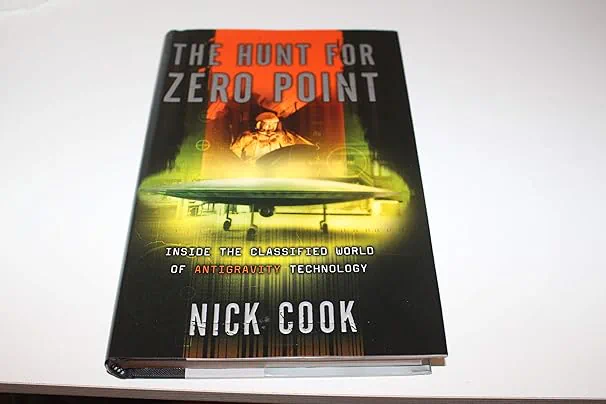
Books by This Guest
Selected titles from the guest bibliography. Use them as context for this appearance, not required listening.
Continue exploring
Paths out of this episode
Stronger next moves anchored to this specific broadcast.