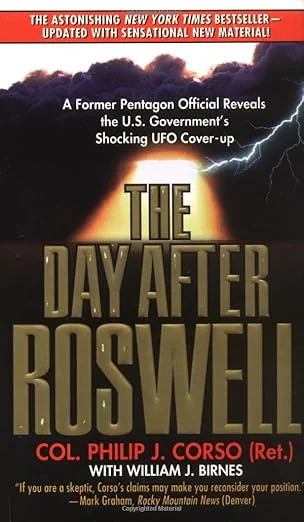
July 23, 1997: The Day After Roswell - Colonel Philip J. Corso & Dr. John Alexander
Corso describes seeing an extraterrestrial body at Fort Riley, Kansas in July 1947, floating in liquid inside one of five crates being transported to Wright-Patterson Air Force Base. He details how General Arthur Trudeau later assigned him a file cabinet containing artifacts from the crash, which he systematically distributed to military laboratories and defense contractors. Among the technologies Corso claims originated from this material are fiber optics, night vision devices, integrated circuits, and irradiated food preservation.
The conversation also covers a secret war involving U.S. reconnaissance aircraft probing Soviet borders, abandoned American POWs, and Project Horizon, the Army's classified plan to establish a military base on the moon. Dr. Alexander notes that Corso's methods created an untraceable path, making the alien origin of these technologies virtually impossible to confirm or deny.
Key Moments
Alexander verifies Corso's Pentagon credentials: Dr. John Alexander says he spent a week in Washington - at the Pentagon, the National Archives, the Army's military history office, and the Army War College - checking Corso's record, particularly his close ties to Lt. Gen. Arthur Trudeau, and confirms Corso did sit in on every session of Trudeau's oral history twenty years after they retired.
The file cabinet from the Roswell crash: Corso recounts being made chief of the Army's Foreign Technology Division in 1961 and having a file cabinet wheeled into his office by Trudeau - containing a shoebox of tangled wires and a grayish foil-like cloth that could not be folded, torn, or creased and bounced back into shape every time.
Night vision goggles from the alien's third eyelid: Corso says the autopsy reports described a third eyelid that acted as a light collector, allowing the creatures to see at night, and that this - combined with German infrared documents he had on hand - became the basis for the U.S. image-intensifier program that produced modern night vision goggles.
Fiber optics seeded from Roswell wires: Corso recalls that the bundle of glowing wires from the Roswell file cabinet - which seemed to emit light without any visible power source - was sent to Fort Monmouth and became the seed of what is now called fiber optics, paid for out of his roughly $2 billion R&D budget.
Preserved source
From the original ArtBell.com archive
The 2003 commemorative archive preserves the contemporary listing for this broadcast. Links and descriptions reflect the original site and may be outdated.
View the original program listingBooks by These Guests
Selected titles from the guest bibliography. Use them as context for this appearance, not required listening.
Collection
More collections featuring this episode
Continue exploring
Paths out of this episode
Stronger next moves anchored to this specific broadcast.