Van Praagh presents his understanding of the afterlife as a multidimensional realm where consciousness determines experience. He describes a world as solid and real as the physical one, with landscapes, homes, schools, and activities, where spirits return to the prime of their lives and reunite with beloved pets. He explains that suicide creates profound consequences as the spirit witnesses the grief it caused, and that capital punishment releases troubled souls at dangerously low vibrational levels where they may influence the living.
The discussion ranges across near-death experiences, the nature of hell as self-created guilt, cloning and its spiritual implications, and the life review process where every effect of one's actions on others is felt firsthand. Van Praagh shares his own childhood vision of a luminous hand descending through his bedroom ceiling that confirmed for him the reality of a loving God force.
Key Moments
Childhood graveyard sighting: two children who died two years earlier: Van Praagh recounts cutting school at age eight, going to a graveyard with two friends, and all three seeing a little boy and girl playing - then walking over and finding the gravestone of a brother and sister who had died two years before.
The life review: feel everything anybody ever felt from you: Van Praagh confirms Dannion Brinkley's account that at death you experience a panoramic life review, feeling every emotion the people you affected felt because of you, then must try to forgive yourself - which Bell calls hell.
First reading: the rose-pedaled footstool from Idaho: Van Praagh describes one of his earliest readings - telling a stranger her grandmother lived in Idaho and was showing him a rose-pedaled footstool, which the woman confirmed her grandmother had needlepointed and kept at her feet.
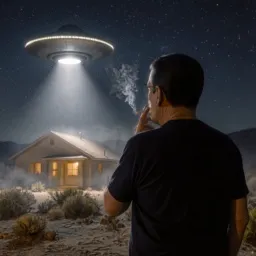
Sedona ranch: lights, Pleiades message, and the underground facility: Van Praagh recounts a private Sedona ranch trip with a ufologist named Richard, watching colored strobing lights with naked eye and binoculars, sensing energy 'pockets' in the field, and receiving a telepathic message from beings he identified as Pleiadian asking why humans struggle to learn about love.
Contact, Jodie Foster, and 'prove it': Bell brings up the scene from Contact where the priest asks Jodie Foster's character if she loved her father and then says 'prove it' - using it to frame Van Praagh's argument that the mediumship reality, like love, is real but unprovable in words.
Preserved source
From the original ArtBell.com archive
The 2003 commemorative archive preserves the contemporary listing for this broadcast. Links and descriptions reflect the original site and may be outdated.
View the original program listingBooks by This Guest
Selected titles from the guest bibliography. Use them as context for this appearance, not required listening.
Healing Grief: Reclaiming Life After Any Loss
Reaching to Heaven: A Spiritual Journey Through Life and Death
Continue exploring
Paths out of this episode
A stronger next move anchored to this specific broadcast.