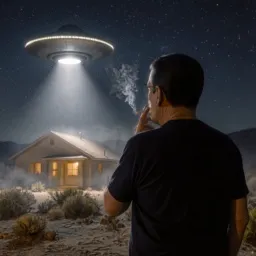
The conversation turns to the future of computing, with Dr. Kaku predicting that Moore's Law will collapse within 20 years as silicon layers shrink to just five atoms across, causing electron leakage. He envisions quantum computers, smart dust for military applications, and a world where the word "computer" disappears from the English language as intelligence becomes embedded in clothing, glasses, and household objects.
Dr. Kaku outlines his civilization classification system, explaining that humanity remains a Type 0 civilization still burning dead plants for energy. He estimates a 10 to 20 percent chance of successfully transitioning to Type 1 within the next century, citing nuclear proliferation as the greatest threat. They discuss Star Wars missile defense, wandering black holes, and whether the universe itself is a bubble floating in 11-dimensional hyperspace.
Key Moments
Our universe may itself be a black hole: Kaku argues our universe satisfies the black hole equation, that we live on the skin of a hyper-bubble, and that no matter where you jump you cannot escape it.
Time travel through a rotating universe: Kaku explains that several solutions of Einstein's equations allow time travel and that walking around a rotating universe in a circle would let you arrive before you left.
Type I, II, and III civilizations: Kaku lays out the Kardashev-style ladder of civilizations: planetary, stellar, and galactic - and tells Art that at our current 3% energy growth Earth will reach Type I in about 100 years.
Why we don't see aliens: Type 0 self-destruction: Asked why the sky is silent, Kaku tells Art that most Type 0 civilizations probably blow themselves up before reaching Type I, and that the silence in space is worrisome.
We are the ants beside an alien superhighway: Kaku uses his anthill metaphor: a Type III civilization could be building a superhighway right next to us and we, like ants, would not perceive or comprehend it.
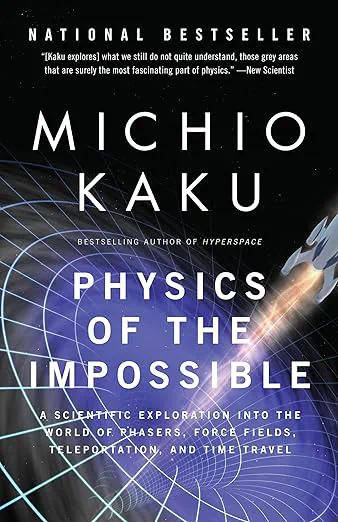
Books by This Guest
Selected titles from the guest bibliography. Use them as context for this appearance, not required listening.
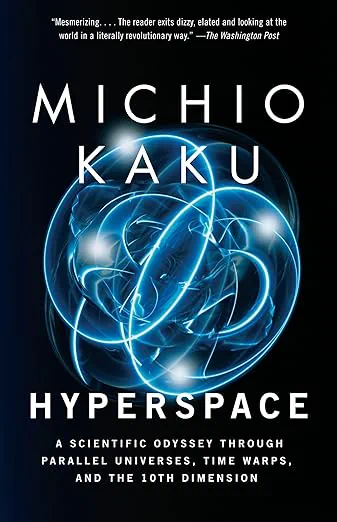
Hyperspace: A Scientific Odyssey Through Parallel Universes, Time Warps, and the 10th Dimension
1994
Continue exploring
Paths out of this episode
A stronger next move anchored to this specific broadcast.