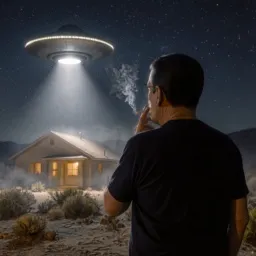
Carroll walks through the science of black holes, describing evidence for a supermassive black hole at the center of our galaxy with a mass millions of times that of the sun. He explains why real time travel, if possible, would resemble space travel rather than the Hollywood version of stepping into a machine and vanishing. The discussion covers upcoming experiments at CERN, why creating a small black hole there would pose no danger, and how gravity is really the curvature of space-time caused by mass and energy.
The conversation also addresses dark energy, the accelerating expansion of the universe, and the mystery of entropy and the arrow of time. Art and Sean explore why time appears to move in only one direction and what the low-entropy state of the early universe tells us about the origins of everything.
Key Moments
Time travel would look like space travel: Carroll dismantles the science-fiction time machine: a real one would not flash and disappear; you would fly off in a rocket through warped spacetime and loop back before you left.
If the Sun became a black hole: Carroll corrects the public misunderstanding: black holes are dangerous because they are small, not because their gravity is strong. If the Sun turned into one tomorrow, Earth would just keep orbiting.
Empty sky in the deep future: Asked where the universe is heading, Carroll confirms that with dark energy driving acceleration, distant galaxies will redshift away until the night sky fades to blackness.
Two meanings of Big Bang: Carroll splits Big Bang into the well-tested expansion scenario and the singularity at T=0 where the theory predicts its own breakdown. He says no physicist actually believes the universe started from literally zero size.
Baby universes from quantum fluctuations: Carroll lays out a serious cosmological scenario: dark energy guarantees space keeps fluctuating, and one fluctuation could pinch off a brand new baby universe, possibly the origin of our own Big Bang.
Books by This Guest
Selected titles from the guest bibliography. Use them as context for this appearance, not required listening.
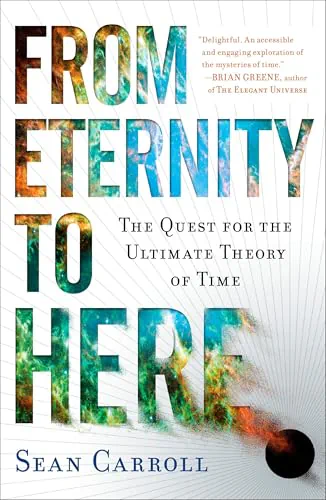
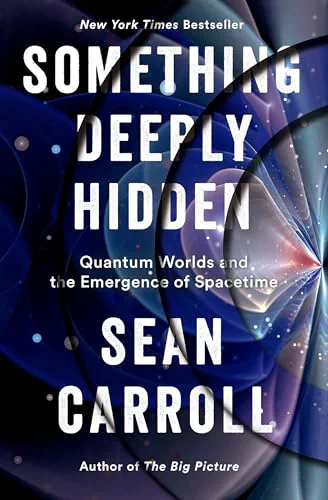
Collection
More in this collection
Continue exploring
Paths out of this episode
Stronger next moves anchored to this specific broadcast.