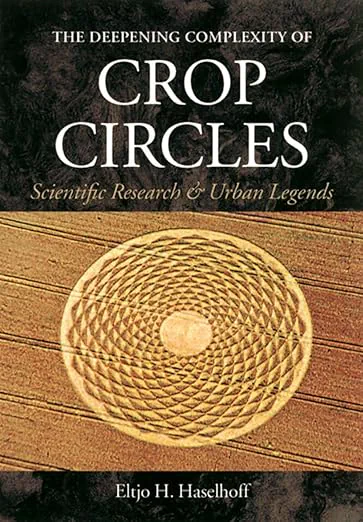
December 17, 2001: Deepening Complexity of Crop Circles - Dr. Eltjo Haselhoff
Haselhoff confirms the findings of American biophysicist Dr. Levengood, particularly the node-lengthening effect in affected plants, which can be replicated using microwave radiation. He presents his peer-reviewed research demonstrating that eyewitness accounts of luminous spheres creating crop formations align with measurable heat signatures found in the crops. One Dutch formation he analyzed contained hidden geometric relationships involving triangles, squares, pentagons, and hexagons, with a probability of occurring by chance calculated at one in 46 million.
When pressed on explanations, Haselhoff acknowledges that conventional physics cannot account for the self-sustaining plasma balls observed near formations. He distinguishes between four types of crop circles and concedes that while some are man-made, the biophysical anomalies and mathematical complexity found in many formations remain genuinely unexplained by mainstream science.
Key Moments
Walking into a 1988 Dutch crop circle: Haselhoff describes physically walking into his first Dutch crop formation in 1988. Stems wouldn't stay flat when stomped, his footprints showed clearly in the soil, but the soil under the laid stems was completely undisturbed and crumbs were so brittle they pulverized.
Confirming Levengood's microwave-cooking effect: Asked about Dr. W.C. Levengood's finding that microwave radiation in a kitchen oven reproduces crop-circle plant changes, Haselhoff confirms he has independently performed similar studies and that the node-lengthening effect can be simulated by simply cooking plants.
Balls of light and node-lengthening match eyewitness accounts: Haselhoff explains that eyewitnesses report balls of light creating crop circles, and his node-lengthening measurements in the field show a perfect match with where these light balls were reportedly seen heating the crops.
1997 Netherlands triangle-square-pentagon-hexagon formation: Haselhoff details a 1997 Dutch formation with a center circle and three concentric rings of slightly different widths. Over two years he proved an equilateral triangle, square, pentagon, hexagon, and pentagram all fit perfectly between the rings. Probability by chance: one in 46 million.
Pushback on Colin Andrews 80 percent man-made claim: Haselhoff respectfully disputes Colin Andrews' widely-cited claim that up to 80% of crop circles are man-made, arguing the figure is premature and based mainly on the south of England, not representative of the global phenomenon.
Books by This Guest
Selected titles from the guest bibliography. Use them as context for this appearance, not required listening.