When Levin joins the program, the conversation shifts to fundamental questions about the shape and size of the cosmos. She discusses her research into the topology of space, explaining how the universe could be finite yet have no boundary or edge, much like the surface of a sphere. The discussion covers how cosmic microwave background radiation might reveal patterns suggesting a finite, wrapped geometry of space.
Art and Levin also explore the nature of infinity, black holes, the Big Bang, and what it means for the universe to be expanding. Callers contribute questions about whether atoms contain miniature universes and the practical implications of a finite cosmos for space exploration and the search for extraterrestrial life.
Key Moments
Extra dimensions could be everywhere but invisible: Levin uses the straw analogy to explain how additional dimensions could be curled up so small that creatures of our size never perceive them.
The universe could pop out of a quantum vacuum: Levin explains how a vacuum is full of the potential for things to exist and that an entire universe could spark into existence and inflate before it pops back out.
Cosmic expansion is accelerating - dark energy: Levin reveals the universe's expansion is speeding up, driven by dark energy that grows stronger as space expands - one of cosmology's biggest recent discoveries.
Godel's rotating universe and backwards time travel: Levin recounts how Einstein's friend Kurt Godel proved that in a rotating universe, traveling backward in time is mathematically permitted by general relativity.
Without Einstein, no atomic bomb: Levin says it's plausible we wouldn't have nuclear weapons without Einstein - not because he built one, but because E equals mc squared made the conversion of mass to energy thinkable.
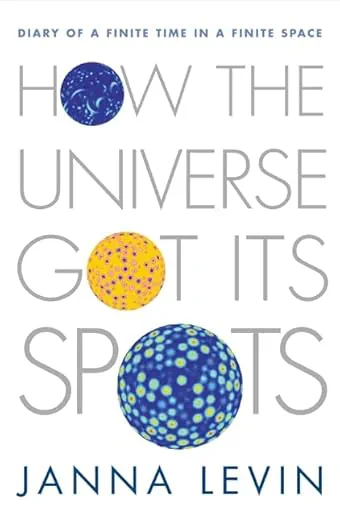
Books by This Guest
Selected titles from the guest bibliography. Use them as context for this appearance, not required listening.