
April 21, 1999: Cold Fusion & Oil Company Coverup - Dr. Eugene Mallove
Mallove reveals that a Department of Energy panel stacked with skeptics produced a negative report that discouraged even oil companies like Amoco from pursuing research despite their own positive results. He describes how MIT researchers allegedly altered their own data to show null results, and how the institutional bias of the academic-government complex has blocked progress for a decade. Multiple private companies, including Clean Energy Technologies and Blacklight Power, have since confirmed excess heat production.
The discussion covers recent breakthroughs by Dr. Les Case involving catalytic fusion that produces measurable helium, the nuclear byproduct skeptics had long demanded as proof. Mallove argues that cold fusion could eliminate fossil fuel dependency entirely, noting that one cubic mile of ocean contains enough fusion fuel to equal all known oil reserves on Earth.
Key Moments
Pons and Fleischmann's 1989 announcement: Mallove recounts how on March 23, 1989, world-class chemists Pons and Fleischmann announced at the University of Utah that they had achieved a nuclear-scale heat reaction in a small jar of water - fusion without millions of degrees - provoking instant controversy.
One cubic mile of seawater equals all known oil reserves: Mallove quantifies the stakes: one cubic mile of ocean contains enough heavy hydrogen, if fused, to equal all known oil reserves on Earth - and there are nearly a billion cubic kilometers of ocean.
Glenn Seaborg's intervention with President Bush: Mallove names Nobel laureate Glenn Seaborg as having walked into President Bush's office on April 14, 1989 - only three weeks after the announcement - and told him cold fusion was not real, despite having done no investigation, while a Princeton hot-fusion physicist publicly called Pons and Fleischmann 'incompetent boobs' based on watching them on TV.
A tank of water could power a car for 100,000 miles: Mallove cites Dr. Randall Mills's claim that 20 gallons of water could run a 200-horsepower car for 100,000 miles, and that a single gallon of heavy water in a cold-fusion reaction could run a car 55 million miles.
How cold fusion is thought to work: Mallove explains the leading hypothesis: hydrogen loaded into a metal lattice such as palladium or nickel undergoes a solid-state fusion reaction producing helium without lethal radiation, and possibly transmutation - a process thousands to millions of times more energetic than chemical combustion.
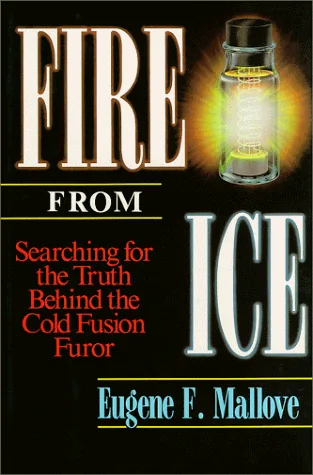
Books by This Guest
Selected titles from the guest bibliography. Use them as context for this appearance, not required listening.
Continue exploring
Paths out of this episode
A stronger next move anchored to this specific broadcast.